
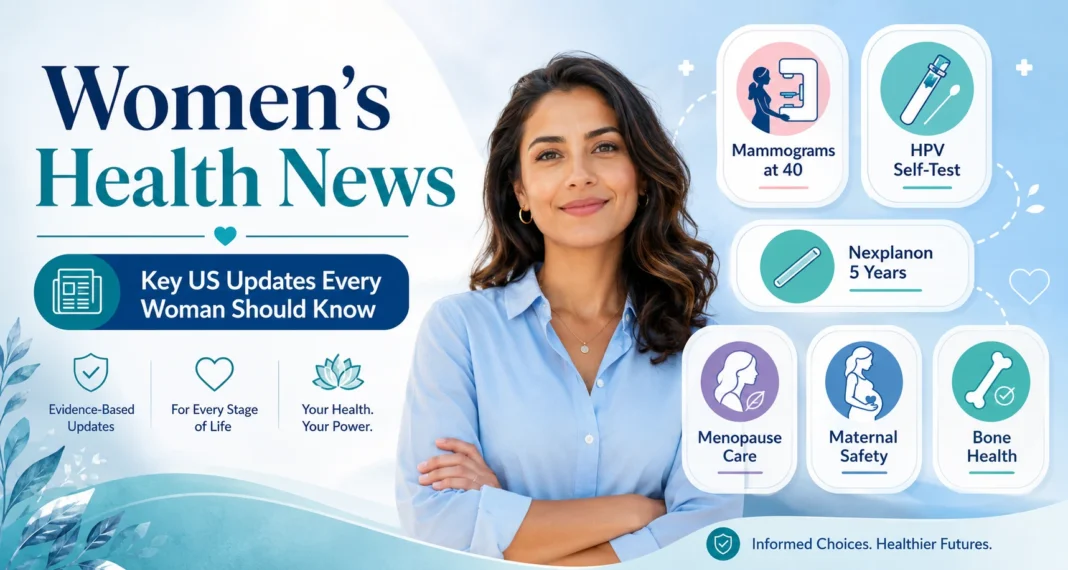
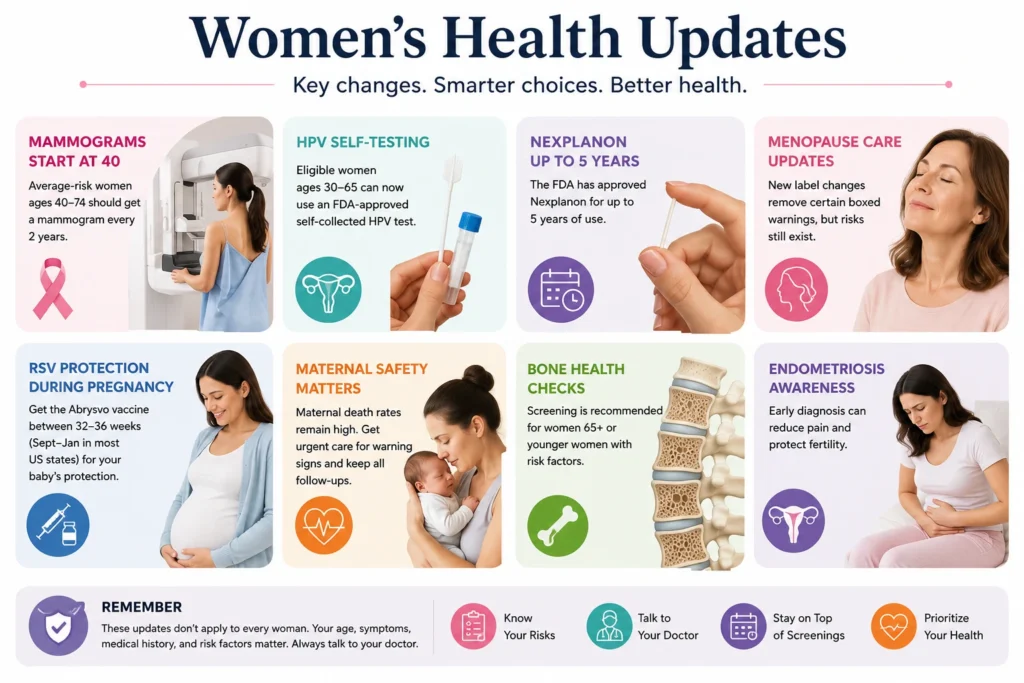
Women’s health news has changed a few common health rules in the US. Mammograms now start at age 40. Nexplanon can last up to five years. Some women ages 30 to 65 can also use a self-collected HPV test.
Also, there are new updates on menopause care, pregnancy vaccines, bone health, and maternal safety. Some of these changes may affect your next doctor visit or test date. Not every update works the same for every woman. Your age, symptoms, old test results, family history, and current health can change the right plan. So do not follow new advice blindly. Check with your doctor first.
How to Read Women’s Health News
Health headlines often leave out the words average risk. A routine test schedule also does not apply when a symptom needs prompt care. Also, the source matters. An FDA label, CDC notice, or final federal recommendation has more weight than a social media post or a short report about one small study.
Medical research often moves in steps. A study may find a possible link. Another team must test it. After that, larger trials may follow. A federal agency may review the results. A test or drug may then receive approval. That process can take years.
Readers should ask three questions when they see a health update:
- Did an official medical body change its advice?
- Does the update apply to women with an average risk?
- Does a symptom or past health issue change the plan?
Those questions can prevent fear, delay, and unsafe self-care.
Women’s Health News on HPV Self-Tests
A pelvic exam can feel painful or stressful. Some women also delay the test due to trauma, disability, culture, transport, or poor access to care. New HRSA guidance now allows eligible women ages 30 to 65 to use an approved self-collected HPV sample. Still, the sample goes to a lab. A random HPV kit sold online may not be safe or valid.
New HRSA guidance now allows eligible women ages 30 to 65 to use an approved self-collected HPV sample. However, finding HPV does not mean cancer was found. Your doctor may order another test to make sure everything is okay. Pap tests are usually done every three years from ages 21 to 29. From ages 30 to 65, an HPV test every five years may be enough.
Ask your clinic:
“Can I use a self-collected HPV test, and will my insurance cover it?”
Age 40 is now the mammogram start point
Breast Screening at a Glance
| Routine mammogram | Higher-risk women | Symptoms that need care |
|---|---|---|
| Average-risk women ages 40 to 74 should have a mammogram every two years. | Earlier or more frequent tests may be needed after breast cancer, a BRCA1 or BRCA2 gene change, chest radiation, a high-risk biopsy, or a strong family history. | See a doctor for a new lump, nipple fluid, skin dimples, nipple changes, breast shape changes, pain in one area, or thick tissue in the breast or armpit. |
| This advice applies to women with no symptoms and no known very high risk. | Dense breasts can hide cancer on a mammogram. MRI or ultrasound may help in some cases, but the choice depends on personal risk. | So, do not wait for your next routine mammogram if a new breast symptom appears. |
Check the breast-density note in your mammogram report. Ask your doctor whether your health history supports another test. Average-risk women ages 40 to 74 should have a mammogram every two years.
Nexplanon now carries a five-year label
The FDA approved Nexplanon for up to five years on January 16, 2026. Ask your clinic to confirm your new removal date. Periods may change, and Nexplanon does not protect against STIs. Contact your clinic if you cannot feel the implant or notice pain, swelling, or numbness.
Women’s Health News on Menopause Care
Menopause hormone therapy often gets reduced to one of two messages. One says it is unsafe. The other says it can solve almost every pMenopause Hormone Labels Have Changed The FDA changed the labels on six menopause hormone products on February 12, 2026. Boxed warnings about heart disease, breast cancer, and probable dementia were removed from those products.
Still, this does not mean hormone therapy is risk-free. Extra care may be needed if you have had breast cancer, blood clots, stroke, heart disease, liver disease, endometrial cancer, or unusual vaginal bleeding.
Because of this, the right option depends on your symptoms and health history. Vaginal creams, pills, patches, and combined hormones do not work the same way. Ask your doctor which type fits your symptoms and whether a nonhormonal option may be safer. Words such as natural or bioidentical do not prove a product is safe.
Veozah now comes with strict liver checks
Veozah is a nonhormonal medicine for menopause hot flashes. The FDA added a boxed liver warning in December 2024. Liver tests are needed before treatment, each month for the first three months, then at months six and nine. Stop the medicine and contact your doctor if you notice yellow skin, dark urine, severe tiredness, nausea, itching, or stomach pain.
RSV protection depends on the exact week
Pregnant women may get the Abrysvo vaccine between 32 and 36 weeks. In most US states, it is given from September to January. Missed the vaccine window? The baby may get an RSV antibody after birth. However, most babies do not need both options. Women who received Abrysvo in a past pregnancy usually do not get it again. Ask your doctor about the right date for your area.
US maternal death figures still demand attention
Maternal Safety Still Needs Attention US maternal deaths stayed high in 2024.
2024 data:
- 649 maternal deaths
- 17.9 deaths per 100,000 births
- Black women had a much higher rate than White women
- Women age 40 and older faced the highest risk
Also, risk can continue after birth, even for several months. Get urgent care for chest pain, trouble breathing, heavy bleeding, severe headache, fever, strong belly pain, vision changes, or thoughts of self-harm. These signs are not normal recovery. Keep your follow-up date and emergency contact details ready.
A bone test can protect future independence
Osteoporosis can weaken bones without pain or another early sign. A broken hip, wrist, or spinal bone may become the first clue. The U.S. Preventive Services Task Force advises a bone-density test for women age 65 and older. It also advises a test for postmenopausal women under 65 when risk factors and a clinical tool show a higher fracture risk.
A DXA scan measures bone density. It can help a doctor estimate the chance of a future fracture. Risk factors may include:
- Low body weight
- Tobacco use
- High alcohol use
- Early menopause
- A parent with a hip fracture
- Certain drugs
- A health problem that weakens bone
Bone health is not only about calcium. Vitamin D, muscle strength, balance, activity, tobacco, alcohol, drugs, and fall risk all matter. As a result, a hip fracture can change daily life for a long time. Federal evidence notes that only about 40% to 60% of people with a hip fracture return to their former level of movement and daily function.
A woman near age 65 should ask when her first DXA scan is due. A younger woman after menopause should ask whether her own risk supports an earlier test.
Endometriosis still has no simple blood test
Endometriosis Pain Should Not Be Ignored There is no simple blood test for endometriosis yet. Endometriosis remains an important women’s health news topic because diagnosis can still take years.
Watch for pain that:
- Stops sleep or work
- Gets worse during periods
- Affects sex
- Comes with bowel or bladder trouble
Tell your doctor when the pain started and how often it returns. This can help with the right scan, exam, or referral.
Women’s health is bigger than reproductive care
Periods, birth control, pregnancy, and menopause matter. They do not cover the full health picture. Women also need care for heart disease, diabetes, mental health, sleep, bone loss, autoimmune disease, chronic pain, and drug safety.
Pregnancy history can give clues about future risk. High blood pressure during pregnancy, gestational diabetes, or an early birth may affect later talks about heart and metabolic health. The age at menopause may also matter for bone and heart care.
A useful preventive visit can cover:
- Blood pressure
- Cholesterol
- Blood sugar
- Cancer tests
- Vaccines
- Mental health
- Sleep
- Bone risk
- Current drugs
- Family history
A normal lab result should not end the visit if pain, fatigue, poor sleep, or unusual blood loss has a major effect on daily life. Good care looks at the test result and the person.
A simple health guide by age
Age does not create a full care plan. It still gives women a useful place to start.
Health care in the 20s
Cervical cancer tests usually begin at age 21 for average-risk women. This decade may also include HPV shots, birth control, sexual health care, mental health support, and help with painful or irregular periods. Severe pain, missed periods, pelvic pain, or blood loss between periods should not be ignored due to young age.
Health care in the 30s
A high-risk HPV test becomes a key part of cervical care. Eligible women may use a patient-collected sample. Fertility questions, pregnancy plans, endometriosis symptoms, blood pressure, and family history may also need more attention.
Health care in the 40s
Routine mammograms start at 40 for average-risk women. Signs of perimenopause may also appear. A hormone shift does not explain every symptom. Heavy periods, blood loss after sex, or blood loss between periods still needs a medical check.
Health care in the 50s and early 60s
Menopause symptoms, hormone choices, heart health, sleep, sexual health, cancer tests, and bone risk often need closer review. A woman with bone risk factors may need a DXA scan before age 65.
Health care from age 65
Routine bone-density tests are advised. Breast cancer tests continue through age 74 for average-risk women under current USPSTF advice. Fall risk, strength, balance, medicine safety, eyesight, hearing, memory, and daily function also matter. Past cancer, a gene change, current symptoms, a weak immune system, or long-term drug use can change any age-based plan.
Take a clear question to the next visit
Medical news becomes useful when it helps a patient ask a better question. A woman does not need to read every research paper. She does need to know whether an official update may affect her care.
Useful questions include:
- Does the five-year Nexplanon label change my removal date?
- Can I use a patient-collected HPV test?
- Does my breast density change my test plan?
- Should I have a DXA scan before age 65?
- Do the new hormone labels affect my menopause choices?
- Which liver tests do I need with Veozah?
- Is this the right time for an RSV vaccine?
- Does my pregnancy history affect my future heart risk?
A short health record can also help. It should list current drugs, supplements, allergies, past surgery, pregnancy problems, family history, test dates, and new symptoms. Dates make symptom notes more useful. “The pain began three weeks ago and now wakes me at night” gives a doctor more detail than “I have pain.”
Keep the date next to the advice
Old medical content can stay online long after a rule has changed. Clinic cards, videos, social posts, and printed handouts can also become out of date. Check the date first. Reliable women’s health news should make medical advice clear and easier to use.
Then check the source. Look for an FDA label, CDC advice, NIH research, HRSA guideline, or USPSTF recommendation. The last check is personal risk. Advice for an average-risk woman may not fit someone with symptoms, a past cancer, a gene change, or an abnormal result. Good health news should make the next step clear. It should not push a reader toward panic, delay, or a self-diagnosis.