

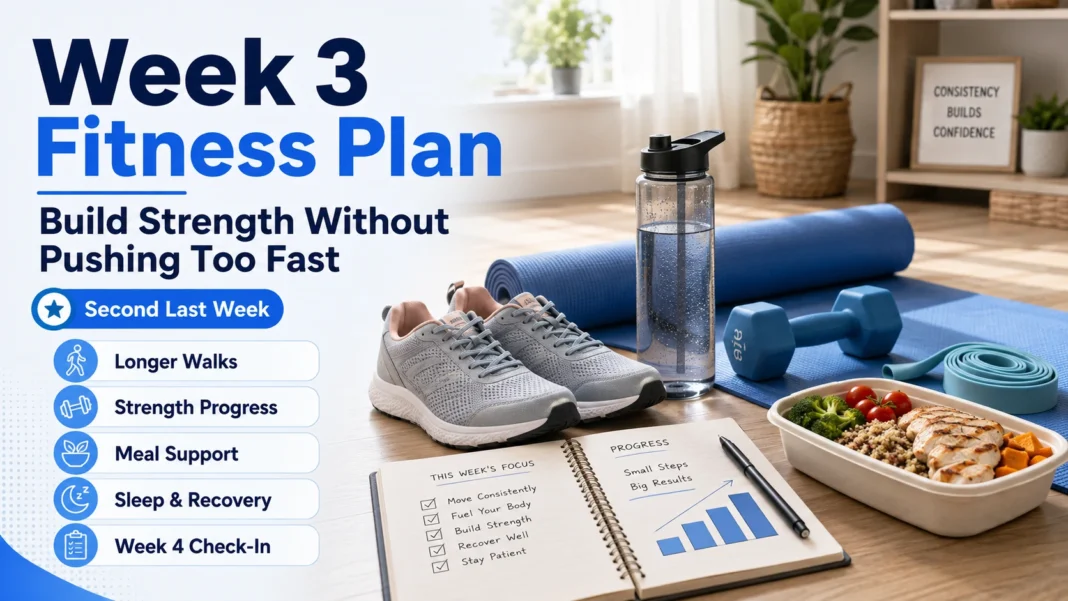
You have already spent two weeks with us, so Week 3 is not about starting over or guessing what your body needs. We now have 14 days of real information to work with, and that makes this week different.
Think back to Day 1. A short walk may have felt unfamiliar, the strength exercises were new, and you were still trying to understand how food, sleep, soreness, and motivation would affect the plan. Now you have your own answers. You know which walks feel comfortable, which exercises still challenge you, when your body needs more rest, and which habits make it easier or harder to stay consistent.
This week, we are going to use those answers carefully. We may add a little more time to a walk, a few controlled reps to a strength session, or simply keep something exactly where it is because it already works. Week 3 is not about making everything harder. It is about making the right things better.
You will also hear directly from our HealthWavy team as you move through the week. Amelia will join you during strength sessions, Jasmine will help you make everyday meals easier to manage, Sofia will check in on sleep, soreness, pain, and recovery, and Marcus will help you compare your progress across the first three weeks.
Our goal is simple: help you become a little stronger, build better stamina, and reach Week 4 with a routine that still feels possible in real life.
Make Sure You Are Ready to Join Us Here
If you arrived at Week 3 without completing the first part of the plan, go back before you start Day 15.
Our Week 1 fitness plan for women over 80 KG helps you find your starting level. It also gives you the first walk, basic strength moves, food checks, rest days, and daily notes that we use later.
If Week 1 is done but Week 2 is not, continue with our Week 2 fitness plan. That week uses your first seven days to adjust activity, food, sleep, recovery, and missed-day problems.
Already completed both? Good. Keep your Week 2 answers close because we will use them throughout this week.
Let Your First 14 Days Choose the Next Step
Do not choose the hardest option because it looks like faster progress. Open your Week 2 review and look at how the plan actually felt. Use this table to find the direction that suits you now.
| Your Last Two Weeks | Your Week 3 Direction |
|---|---|
| Walks and strength felt easier | Add a small amount |
| Most sessions felt about right | Make one small change |
| You finished most days but often felt tired | Stay close to Week 2 |
| You missed several sessions | Focus on a routine you can follow |
| Pain affected a move | Do not increase that move |
Marcus here. I do not want you to judge progress from reps alone. If your chair sit to stand feels smoother, that matters. If a walk that once felt difficult now feels normal, that matters too. Less fear before exercise, better control, and an easier return after a missed day also give us useful information.
CDC recommends that adults work toward at least 150 minutes of moderate-intensity activity each week and include muscle-strengthening work on at least two days. Those minutes can be spread through the week and split into smaller periods. That is a long-term target. We are not asking you to force your body to reach it this week if your current level is lower.
Choose Your Week 3 Level
We will use three levels from Day 15 onward. Pick the one that matches your Week 2 results, not the one you wish you could choose.
Level A: Ready for a small step up
Use this level if Week 2 felt comfortable, you recovered well, and the exercises did not cause clear pain.
Level B: My current level still feels right
Choose this if you completed most sessions but they still required enough effort. You are progressing, but there is no need for a big change yet.
Level C: I need more time at this level
Use this if you missed several sessions, felt very tired, or found Week 2 hard to complete. Level C is not a failed version of Week 3 and It gives you a way to continue without pretending your last week was easier than it was. Keep your level for the first few days. We can adjust later if your body gives us a clear reason.
Day 15 See How Your Walk Feels Now
Day 15 gives us our first clear test of Week 3. We do not need a harder workout yet. First, we want to see how your body responds to a walk after two full weeks of regular activity.
Use the level you chose from your Week 2 results. Pick your time from the table below and stay with it, even if you feel able to do much more today.
| Week 3 Level | Day 15 Walk |
|---|---|
| Level A | 20 to 25 minutes |
| Level B | 15 to 20 minutes |
| Level C | 10 to 15 minutes |
Walk at a pace that feels comfortable but active. You should notice some effort, but you should not have to push hard just to reach the planned time. Today is not about speed, distance, or step count. We want to see how the same basic activity feels after the work you did in Weeks 1 and 2. Pay close attention to the start and end of your walk. During the first five minutes, notice your legs, breath, and general comfort. Do the same during the last five minutes.
When you finish, choose the answer that fits best:
| Day 15 Check | Your Answer |
|---|---|
| First five minutes | Easy / Fine / Hard |
| Last five minutes | Easy / Fine / Hard |
| Breath | Comfortable / A little heavy / Too hard |
| Legs | Good / Tired / Very tired |
| Could you do this walk again on another normal day? | Yes / Maybe / No |
Your answers matter more than the number of minutes.
A walk that starts a little hard but becomes comfortable may show that your body simply needs time to settle into the session. A walk that feels fine at first but becomes very difficult near the end may tell us that your current time is enough for now. If the whole walk feels easier than it did during Week 1, that gives us a useful sign of progress.
Amelia Here – Save Some Energy for the Rest of the Week
If today’s walk feels much easier than you expected, I still do not want you to add another 15 or 20 minutes just because you can. Week 3 has strength work and another walk ahead. I want you to finish Day 15 with enough energy to come back tomorrow and follow the plan well.
If your selected time feels easy from start to finish, mark that in your notes. We can use that result later this week. If the walk feels too hard, there is no need to prove anything. Reduce the pace or stop sooner if you need to.
Your Day 15 goal is not to set a record. It is to find out whether the level that challenged you before now feels easier to control.
Day 16 Let’s Add a Little Strength
You already know today’s exercises, which is exactly what we want. A new move would make comparison harder. Using familiar exercises lets us see whether your control and strength have changed. Spend about five minutes with easy movement first. Then use your Week 3 level.
| Exercise | Level A | Level B | Level C |
|---|---|---|---|
| Chair sit to stand | 10–12 reps | 8–10 reps | 5–8 reps |
| Wall push-up | 10–12 reps | 8–10 reps | 5–8 reps |
| Supported calf raise | 12–15 reps | 10–12 reps | 6–10 reps |
| Slow march | 40–45 sec | 30–40 sec | 20–30 sec |
Complete one controlled round first. Level A can add a second round if the first round feels comfortable and your form stays steady. Level B can add another round if the first one still leaves you in control and level C can finish after one round.
Change One Thing, Not Everything
I want you to avoid a common Week 3 mistake and do not add more reps, another round, and more speed all on the same day. Pick one small change.
If you add two reps, keep the normal pace. If you add a second round, keep the first rep count, if you need a longer rest between moves, take it. Good form matters more than a fast finish. When you complete the session, tell me two things:
Which move felt strongest today?
Chair sit to stand / Wall push-up / Calf raise / Slow march
Which move still needs the most work?
Chair sit to stand / Wall push-up / Calf raise / Slow march
Keep both answers. We are coming back to them on Day 19.
Day 17 Make the Walk Feel More Purposeful
Today we can ask a little more from the walk, but we still do not care about racing someone else’s pace.
Use your level:
| Week 3 Level | Day 17 Walk |
|---|---|
| Level A | 25 to 30 minutes |
| Level B | 20 to 25 minutes |
| Level C | 10 to 20 minutes |
Let the pace feel purposeful rather than rushed. CDC describes moderate activity as effort that raises breathing and heart rate but still allows conversation. Halfway through the walk, check yourself.
Could I keep this pace for the rest of the session without forcing it?
If yes, stay there. If you are unsure, ease the pace a little, if the effort already feels too high, slow down. That is not a failed walk. You just made an adjustment before exhaustion made the choice for you.
Jasmine Here – Give Me Two Meals You Can Rely On
We have spent two weeks talking about food problems. Today I want something more useful from you.
Think of two meals that usually work well in your real life.
I am not asking you to create two perfect “fitness meals.” I want meals you can make, buy, or put together without turning food into another difficult task. Maybe breakfast is eggs, whole-grain toast, and fruit. Maybe you prefer yogurt, oats, fruit, and nuts. Lunch could be lentils with vegetables and roti, or chicken with rice and vegetables.
Your culture, budget, schedule, and preferences all matter.
Choose:
- Reliable meal 1: Breakfast / Lunch / Dinner
- Reliable meal 2: Breakfast / Lunch / Dinner
Now decide what those two meals normally include. We will use them again later this week.
Day 18 Give Your Body a Quieter Day
You have already walked twice and completed one strength session this week. Day 18 gives us a chance to see how well your body handled that work. If you feel good, you can take an easy 10 to 15-minute walk. If your legs still feel heavy or your energy feels low, take a rest day.
Neither option needs guilt attached to it.
Sofia Here -Tell Me What Your Body Says Today
Before you decide whether to walk, check four areas with me.
- Legs: Fresh / A little sore / Very sore
- Knees or joints: Fine / Mild discomfort / Pain
- Energy: Good / Fine / Low
- Sleep: Good / Fair / Poor
If your muscles feel mildly sore but the rest of you feels fine, an easy day may be enough. If your body still feels very tired, stay with the lower activity option. Pain deserves more care. A knee, hip, ankle, shoulder, or back area that hurts again and again is not something I want you to cover up with extra reps.
People with chronic conditions or disabilities may need activity choices that fit their abilities. CDC advises people in these groups to consult a health professional or physical activity specialist when they need help choosing suitable types and amounts of activity.
Let’s Check Last Night Too
Low energy does not always mean low motivation. Adults ages 18 to 60 generally need 7 or more hours of sleep each night, according to CDC guidance.
If your sleep has been poor, choose one problem to work on tonight. Maybe your phone stays with you too late. Maybe your bedtime changes every day, maybe the room never feels quiet enough.
Do not try to rebuild your whole night routine at once. Pick one change and see how tomorrow feels.
Day 19 Come Back to Your Day 2 Exercises
This is one of my favorite checks in the whole four-week plan because we can finally compare the same strength work across enough time to make the comparison useful.
Go back to your chair sit to stands, wall push-ups, supported calf raises, and slow march. Use your Day 16 level unless that session clearly felt too easy or too hard. Now forget the number of reps for a moment.
Think about how each move feels.
| Exercise | Compared With Day 2 |
|---|---|
| Chair sit to stand | Easier / Same / Harder |
| Wall push-up | Easier / Same / Harder |
| Supported calf raise | Easier / Same / Harder |
| Slow march | Easier / Same / Harder |
Amelia here again. If two or three moves now feel easier, I do not want you to celebrate with a huge jump in reps. That would miss the point.
A movement that feels smoother is already giving us useful progress. A second controlled round may be enough if your level allows it. I want you to leave Day 19 with confidence and enough energy to continue tomorrow.
Strength Does Not Need to Look Dramatic
You may still use the same chair, wall, and walking route. Progress can still be real. Fewer pauses, better control, easier chair stands, and faster recovery all count. A 20-minute walk may also feel easier than it did before. CDC notes that some physical activity is better than none. The goal is simple build a routine your body can handle and your daily life can keep.
Day 20 Try Your Longest Comfortable Walk
Today can be your longest walk so far.
The important word is comfortable.
Use this range:
| Week 3 Level | Day 20 Walk |
|---|---|
| Level A | 25 to 30 minutes |
| Level B | 20 to 25 minutes |
| Level C | 15 to 20 minutes |
Already reached that time earlier this week and found it difficult? Repeat the easier time instead of adding more. You can also split the session. If 30 minutes does not fit your day, two 15-minute walks are fine. CDC guidance allows adults to spread weekly activity across the week and break it into smaller periods.
Marcus Here – I Need Three Answers, Not a Step Count
Forget how far someone else walked.
After your session, tell me:
- Breathing: Easy / Controlled / Too hard
- Legs: Good / Tired / Very tired
- Could I reasonably repeat this walk on another normal day? Yes / Maybe / No
That last answer gives us the best information. If you choose No, I do not want the next walk to become longer. We first need this level to fit your normal week.
Day 21 Review Your Progress From All Three Weeks
You have reached the end of Week 3. Today is not about adding another hard workout. It is time to look at what changed across the last 21 days. Do not use the scale as your first test. Your weight is only one part of the picture. Open your Week 1 and Week 2 notes, then complete this short review.
| Week 3 Review | Your Answer |
|---|---|
| Days completed | ___ / 7 |
| Walks feel | Easier / Same / Harder |
| Strength feels | Easier / Same / Harder |
| Recovery | Good / Mixed / Poor |
| Energy | Better / Same / Lower |
| Food routine | Better / Same / Harder |
| Hunger | Easier / Same / Harder |
| Sleep | Better / Same / Worse |
| Pain | None / Mild / Concerning |
| Week 3 felt | Too easy / About right / Too hard |
Now compare these answers with your first week. Ask yourself one useful question:
What can I do now that felt difficult on Day 1?
Your answer may have nothing to do with weight. A 20 or 25-minute walk may feel easier now. Chair stands may require less effort. You may recover faster after exercise or feel more confident when a session starts. Your food routine may also feel easier to manage. Do not look for a dramatic result. Look for a real change. We will use that progress to choose the right level for Week 4.
Jasmine – Let’s Make Your Meals Easier to Repeat
We worked on one main food problem in Week 2. This week, I want you to move one step further. Your meals should start to feel easier to manage on normal days, not only when you have plenty of time.
A simple meal can start with:
Protein + fruit or vegetables + a fiber-rich food + a suitable drink
You can build this from food you already enjoy. Eggs with whole-grain toast and fruit can work well. Lentils with vegetables and roti are another option. You may prefer chicken with rice and vegetables, fish with potatoes and salad, or yogurt with fruit and nuts. You do not need special diet foods or a strict menu. I want you to have a few normal meals that suit your budget, schedule, and home life.
Check the Two Meals You Chose Earlier
Go back to the two reliable meals you picked on Day 17. Ask whether they still make sense after you tried them in real life. Could you prepare or buy them on a busy day? Did they keep you comfortable until your next meal? Would you be happy to eat them again after this four-week plan ends? If one meal did not work, replace it. You are not required to keep a choice just because you wrote it down earlier.
Your Week 3 food goal is simple: find two reliable meals that make healthy choices easier when life gets busy.
Hunger Rose This Week?
A little more activity can make hunger feel different for some people. Do not respond by cutting food harder without looking at the rest of the day.
Ask whether you skipped a meal. Think about whether breakfast was enough. Check whether your meals included useful protein and fiber. Look at whether you completed a longer walk and then went several hours without food. CDC notes that fiber helps people feel fuller for longer and lists fruits, vegetables, whole grains, legumes, nuts, and seeds as good fiber sources.
Jasmine: If you are hungry all day, I would rather see you improve the structure of the meal than simply make the portion smaller. Persistent or unusual hunger needs more attention if it is severe, appears with other symptoms, or starts after a medicine change.
Cravings Can Still Happen
Cravings can still show up in Week 3. That is normal. A better routine does not mean you will stop wanting dessert, snacks, or your favorite foods. If you eat something outside your usual plan, do not punish yourself the next day. There is no need to skip breakfast, cut your meals, or add an extra workout. Return to your normal routine at the next meal.
Jasmine here. I want you to notice what was behind the craving. Ask yourself, “Was I hungry, tired, stressed, bored, or did I simply want that food?”
There is no wrong answer. The goal is to understand your habits so you can make better choices without fear or guilt.
Restaurant Meals Can Fit Your Week
You will not eat every meal at home after this four-week plan ends. Family dinners, work lunches, restaurants, and social events are part of normal life. Your routine needs to work around them.
At a restaurant, choose a meal that suits you. Add a source of protein if it is available. Fruit, vegetables, beans, or other plant foods can also help make the meal more balanced. Eat until you feel comfortable rather than treating the meal as a chance to forget the plan.
CDC healthy meal guidance also supports practical food choices both at home and away from home. A restaurant meal does not ruin your week. Enjoy it, then return to your usual meals. You do not need an extra workout to make up for it.
A Poor Night of Sleep May Change Today’s Plan
If you slept badly last night, tell me before you decide that you lack motivation. Low energy may simply mean your body needs a lighter day. You can shorten your walk, complete one strength round instead of two, or keep the same number of reps. A rest day may also make sense if you feel very tired.
One poor night does not erase the work you have done. Adjust today if you need to, then return to the plan when your energy improves.
Our goal is not to force every session and we want a routine that still works on days when life does not go as planned.
Soreness and Pain Need Different Attention
A little muscle soreness can happen after strength work, especially after you add more reps or another round. It may simply mean your muscles worked harder than usual. Sharp or repeated pain is different. Pay attention if the same knee, hip, ankle, shoulder, or back area hurts each time you exercise. Do not make that move harder. Use an easier version or leave it out until you know what causes the pain.
Sofia: I want you to listen to pain instead of trying to push through it. Week 3 should help your body get stronger, not make an existing problem worse. Seek medical advice if pain lasts, gets worse, or starts to affect normal daily tasks.
What If the Scale Has Barely Moved?
Three weeks of effort can make you expect a clear change on the scale. If that number has barely moved, do not decide that your work has failed. I want you to look at your full three-week record first. Compare your walks with Day 1. Check whether the Day 19 strength session felt easier than Day 2. Think about your energy, recovery, meals, sleep, and how often you completed the plan.
Weight can change for many reasons. Food, physical activity, sleep, stress, medicines, health conditions, hormones, age, and other factors can all play a part. CDC guidance also notes that gradual weight loss of about 1 to 2 pounds per week is more likely to last than faster loss. If weight loss is one of your goals, you can still track it. Just use it as one part of your progress, not the only result that matters.
Missed a Strength Day? Just Continue
A missed session does not mean you need to fix the whole week. Do not place two strength workouts on the next day just to catch up. Check your schedule first. If another strength day is still ahead, follow it as planned. If not, return to strength work at the next planned session.
Marcus: I want this routine to work even when a day does not go as planned. You do not owe the plan an extra workout because you missed one. Use the same idea with food and walks. One heavy meal does not call for less food the next day. One missed walk does not mean you need twice the time tomorrow.
Return to your normal plan and keep going.
Motivation Feels Lower This Week?
Week 1 had something Week 3 does not have: the excitement of a new start. That change gives us useful information. Now we can see whether the routine fits your real life.
Instead of asking, “How do I get my motivation back?”, ask:
“What makes today’s session hard to start?”
Maybe you do not have enough time after work. Your usual route may feel dull. Poor sleep may have left you tired. A result on the scale may also have affected your mood. Once you know the problem, make the session easier to start. A 15-minute walk may fit a busy day better than a 30-minute target. One strength round may make more sense than no workout at all.
You do not need a perfect day. You need a version of the plan you can actually do today.
Your Period May Affect This Week
Your period may change your energy, comfort, or usual exercise level for a few days. Let your symptoms help you choose the right option. If you feel well, stay with your normal level. If cramps, fatigue, or discomfort make exercise harder, use the easier option or take a rest day.
Do not try to make up for those easier days later. They are still part of your week. Severe pain, faintness, very heavy bleeding, or symptoms that feel unusual need medical attention. A harder workout is not the right response to those signs.
A few lighter days do not erase the progress you made during the rest of the month.
Keep Your Week 3 Record Simple
You do not need a long diary at this stage. We only need enough information to see how Week 3 worked in your real life.
At the end of each day, complete this quick check:
| Daily Check | Choose One |
|---|---|
| Activity | Done / Partly / Rest / Missed |
| Effort | Easy / Right / Hard |
| Food | Good / Mixed / Difficult |
| Energy | Low / Fine / Good |
| Sleep | Poor / Fine / Good |
| Pain | None / Mild / Concerning |
| Recovery | Ready / Need more time |
Give this about one minute each day. Honest answers matter more than detailed notes. At the end of Week 3, these seven records will help us decide whether Week 4 should move up slightly, stay at the same level, or become easier in a few areas.
Let’s Decide Together If You Are Ready for Week 4
We have spent three weeks with your walks, strength work, food, sleep, and recovery. Give us a clear picture of how this week felt. Your answers will help us choose the right direction for your final seven days.
I’m checking your strength and whether a small increase makes sense.
I’m checking whether your meals now feel easier to manage.
I’m looking at recovery, sleep, soreness, and pain.
I’ll use your three-week pattern to guide the final week.
Do not choose “Yes” because it sounds like the best answer. An honest “No” may be exactly what helps us keep Week 4 at the right level.
Before You Finish Week 3
You have completed 21 days of the plan. Take a few minutes to look at the week as a whole before you move ahead. Do not judge it from one hard day or one missed session. Compare this week with your Week 1 fitness plan and your Week 2 fitness plan. Think about what now feels easier, what still takes effort, and what caused the most trouble.
Use this quick review:
| Week 3 Check | Your Answer |
|---|---|
| Strongest day | Day 15 / 16 / 17 / 18 / 19 / 20 / 21 |
| Hardest day | Day 15 / 16 / 17 / 18 / 19 / 20 / 21 |
| Biggest change | Walks / Strength / Food / Sleep / Energy / Confidence / None yet |
| Main challenge | Time / Pain / Hunger / Food / Sleep / Motivation / Work or family |
| Week 3 felt | Too easy / About right / Too hard |
Now think about one question that matters more than the rest:
What would you like to handle better in Week 4?
Your answer can be simple. You may want to complete each planned walk, feel more comfortable with chair stands, improve your meals, or get through a full week without the plan taking over your day. There is no perfect answer. We only need an honest one because your final week should match the person you are now, not the person who began on Day 1.
Need Help Before Week 4?
If a Day 15 to Day 21 step still feels unclear, email us at info@healthwavy.com. Tell us which part caused trouble, and the HealthWavy team can help you understand the guide.
This plan offers general wellness information. It does not replace personal medical care. Talk with an appropriate health professional if pain lasts, becomes worse, affects daily tasks, or if you have health symptoms that need personal advice.
One Final Week Is Left
You have already done the work that makes the last week useful. Week 1 helped us learn what your body could handle, Week 2 helped us adjust the plan from your first results and week 3 added a little more strength and stamina where it made sense.
Week 4 will bring all of that together. We will look at your walks, strength work, meals, sleep, recovery, difficult days, missed sessions, and the parts that now feel easier. At the end of Day 28, you will compare your first week with your last week and decide what kind of routine makes sense after this one-month plan.
If Week 3 felt comfortable, we can add one small challenge. If it felt about right, several parts may stay exactly the same, if it felt too hard, we will reduce the pressure instead of making the last week harder just because it is Week 4.
You do not need to finish the month with your hardest workout. You need to finish with a routine that still makes sense after Day 28.
Coming Next
Week 4 Fitness Plan Finish Strong With a Routine You Can Keep
Our final week will complete the full four-week plan. We will bring your walks, strength work, food routine, sleep, and recovery into one clear schedule. Day 28 will also give you a full month review so you can choose your next step: keep your current level, add a small challenge, or repeat the part of the plan that still needs more time.
Unsure About Your Week 4 Level?
Ask HealthWavy AI about your Week 3 results. You can ask if your walk should stay the same, if missed days matter, or if soreness means you should slow down.
Use chat or voice. It provides educational guidance based on the plan.
Ask About My Week 3 Results →