

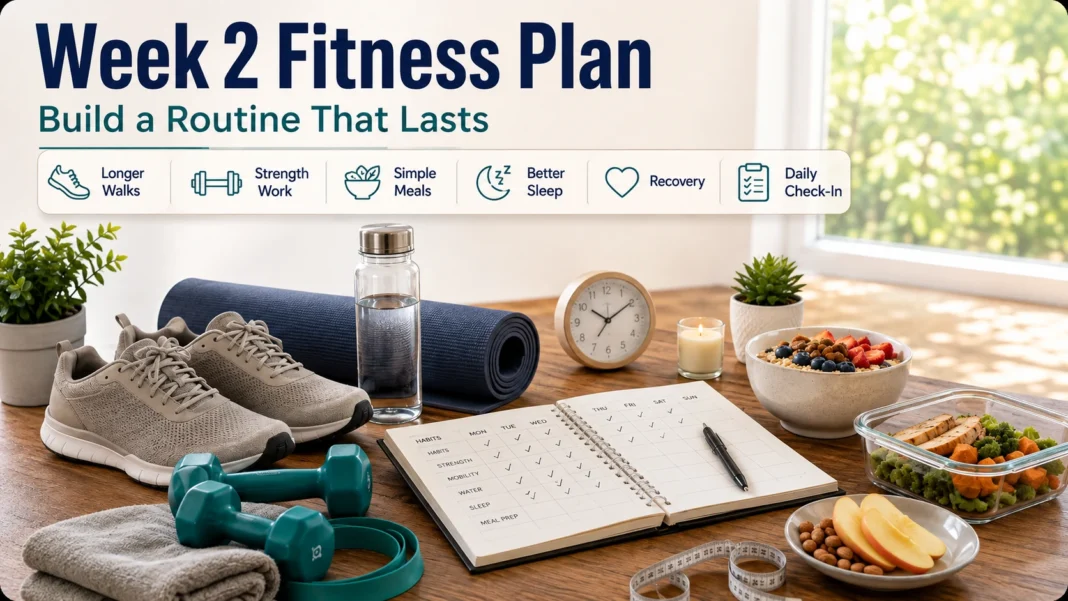
Week 2 starts with what you learned in Week 1. You now know which walk felt easy, which exercise felt hard, how your sleep affected your energy, and which food habit caused the most trouble. Amelia wants a small increase in activity, Jasmine wants one food habit fixed, Sofia wants recovery to stay in the plan, and Marcus wants your Week 1 notes to guide the next step.
Open your notes before you start. We are not starting again. We are keeping what worked and changing what did not.
Pull Out Your Week 1 Notes
Do not rely on memory here. Look at what you wrote at the end of Week 1 and answer these questions again.
| Look Back at Week 1 | Your Answer |
|---|---|
| Days completed | ___ / 7 |
| Walk felt | Easier / Same / Harder |
| Strength work felt | Easier / Same / Harder |
| Energy | Better / Same / Worse |
| Sleep | Better / Same / Worse |
| Hunger | Fine / Hard to manage |
| Pain | None / Mild / Concerning |
| Plan felt | Easy / Right / Too hard |
| Main food problem | ______ |
| Main reason you almost stopped | ______ |
One answer matters more than the rest: Did Week 1 feel too easy, about right, or too hard?
Keep that answer in front of you. Your Week 2 level depends on it.
Start With Week 1 First
If you have not completed the first seven days yet, start with Week 1. Your Week 1 results help you choose the right activity level for this week.
Go to Week 1 Fitness Plan →Amelia Does Not Want Everyone to Add More
Amelia raised an important point when we planned this week and a person who completed seven comfortable days should not get the same Week 2 plan as someone who struggled through three days with knee pain. That sounds obvious, but fitness plans often ignore it.
Use this simple rule:
- Week 1 felt easy: add a small amount.
- Week 1 felt right: add only a little.
- Week 1 felt hard: keep the same level or choose the easier option.
CDC guidance says adults should work toward at least 150 minutes of moderate physical activity each week and muscle work on at least two days. It also makes clear that activity can be split into smaller parts and that some activity is better than none. Week 2 moves you closer to that long-term target. It does not force you to reach it before your body is ready.
What We Want From Week 2
Week 1 helped you start. This week, we want to take what worked and make it a little better without turning the plan into something hard to follow.
Amelia wants you to add a little more movement, but only if last week felt comfortable. Two strength days will stay in the plan, with a few extra reps where your body feels ready. Jasmine wants you to choose one food habit that caused trouble last week and work on that instead of changing your whole diet.
Sofia also wants rest to stay part of the plan. A busy day, poor sleep, or low energy should not make you feel that the week is lost. Marcus agrees that progress should come from steady habits, not from a sudden push that you cannot maintain.
So this week, focus on a little more activity, better control of one food habit, enough rest, and a routine you can come back to even after a difficult day.
Day 8 Let’s See What Week 1 Taught Us
You are back, and we do not want to make today harder just because a new week has begun. Your Week 1 record should decide the next step.
Pick the option that fits your first week best:
A. I completed most days and felt good.
You are ready for a small step up.
B. I completed most days, but the plan felt hard.
Stay close to your Week 1 level.
C. I missed several days.
Do not try to catch up. Start from a level you can follow again.
D. I had pain or unusual discomfort.
Do not add more effort to a move that hurts. Pain that stays, gets worse, or affects daily life may need medical advice.
Choose Your Walk Today
| How Week 1 Felt | Day 8 Walk |
|---|---|
| Easy | 20 minutes |
| About right | 15 to 20 minutes |
| Hard | 10 to 15 minutes |
| Several days missed | 10 minutes |
Keep the pace under control. You should finish with a clear idea of how your body handled the walk, not with a need to prove that you can do more. Marcus asked us not to focus too much on the number of minutes. If 15 minutes felt comfortable and you had energy left, note that. If 10 minutes felt like enough, note that too. Both answers help us choose the right next step.
Before You Finish Day 8
Compare today with Day 1.
How did the walk feel now?
Much easier / A little easier / About the same / Harder
Keep your answer. We will use it again before the end of Week 2.
Day 9 Strength Comes Back
You already met these exercises last week, so today should not feel like a surprise test. Amelia wanted the same basic moves because progress becomes easier to notice when you compare the same task. Start with about five minutes of easy movement. Then use this table.
| Exercise | Easier Week 1 | Normal Week 1 | Hard Week 1 |
|---|---|---|---|
| Chair sit to stand | 8 to 10 reps | 6 to 8 reps | 5 to 6 reps |
| Wall push-up | 8 to 10 reps | 6 to 8 reps | 5 to 6 reps |
| Supported calf raise | 10 to 12 reps | 8 to 10 reps | 6 to 8 reps |
| Slow march | 30 to 40 sec | 20 to 30 sec | 15 to 20 sec |
Complete one controlled round and second round is optional if your first week felt comfortable and you have no pain from these moves. Do not turn good progress into a reason to rush.
Amelia Wants Better Reps, Not Faster Reps
Amelia does not want you to race through the strength work. She wants each rep to feel steady and controlled. Take your time with chair sit to stands, keep wall push-ups smooth, and let your calf raises stay slow enough that you control both the rise and the return. Fast reps may help you finish sooner, but that is not our goal today. Good control helps you see whether your strength and confidence have changed since Day 2.
Now think back to that first strength session.
Which exercise feels easier now than it did on Day 2?
Chair sit to stand / Wall push-up / Calf raise / Slow march / None yet
Keep your answer. We will compare it again at the end of Week 2.
Day 10 Fix the Food Habit That Keeps Getting in Your Way
Jasmine does not want a new diet today. She wants you to look back at Week 1 and choose the food habit that caused the most trouble. Maybe it was late-night snacks, sugary drinks, large portions, sweets, fast food, skipped meals, or hunger that seemed to return all day. Choose one problem. Trying to fix everything at once can make the week harder than it needs to be.
Sugary Drinks Keep Showing Up
Start with one drink you have often. Replace it with water or another option with no added sugar. You do not need to promise that you will never have a sugary drink again. Jasmine wants a change that still feels possible next month, not just today. CDC notes that sugary drinks can add a lot of added sugar to the diet and suggests water as a simple alternative.
You Keep Missing Meals
Look at the time of day when this happens most. If lunch disappears because work gets busy, decide what you can prepare or choose before that busy part of the day starts. Keep the meal simple. A useful option can include protein, fruit or vegetables, a whole grain or another fiber-rich food, plus a drink that suits you. Do not wait until you feel extremely hungry to decide what to eat.
Portions Feel Hard to Control
Do not suddenly make every meal tiny. Put your meal on a plate when you can, eat at a normal pace, and give yourself time to notice when hunger starts to settle. Large packets and distracted meals can make it harder to notice how much you ate.
Your goal today is better control, not the smallest portion possible.
Late-Night Snacks Are the Main Problem
Jasmine wants you to look earlier in the day before you blame the snack.
Ask yourself:
- Did I skip lunch?
- Was dinner too small?
- Did I stay awake much later than usual?
- Was I stressed or bored?
- Was I truly hungry?
Your answer tells you what may need attention. A late snack is not always the real problem.
Your Day 10 Choice
Before you finish today, decide on one food change you can repeat for the rest of Week 2.
My focus: Sugary drinks / Missed meals / Portions / Late snacks / Sweets / Fast food / Hunger / Something else
Keep that choice simple. Jasmine only wants one habit from you this week, but she wants you to actually work on it.
If you want more simple exercises you can do without gym equipment, see our home workout guide.
Day 11 Give Your Body Some Space
Sofia asked us to keep Day 11 light on purpose. You have already added walks and strength work this week, so today is a chance to see how well your body has handled it. If you feel good, take an easy 10 to 15-minute walk. If your legs feel heavy, your muscles still feel sore, or your energy is low, choose a rest day instead. You do not need to earn rest with another workout.
Sofia Wants an Honest Check
Before you decide what to do today, ask yourself:
- Does anything hurt?
- Do I feel normally tired or unusually exhausted?
- Did I get enough sleep last night?
- Do I feel ready for tomorrow?
Let those answers guide your choice. A lighter day will not slow your progress. It can help you return to Day 12 in better shape.
Look at Your Sleep Tonight
Low energy does not always mean low motivation. Sofia wants you to check your sleep before you blame yourself. CDC says adults ages 18 to 60 generally need 7 or more hours of sleep each night. A regular bedtime, a calm bedroom, and less screen time near bed can also support better sleep.
Do not try to fix your whole routine tonight. Choose one small change:
- Put your phone away a little earlier.
- Go to bed at a more regular time.
- Skip a very large late meal if it affects your sleep.
- Make your room quieter and more comfortable.
Pick the one that fits your life best.
Day 11 is not an empty day. Today you learn whether your body needs movement, rest, or better sleep before we add the next step.
Day 12 Let Your Last Walk Decide Today
Amelia does not want you to add time just because Day 12 has arrived. Look back at Day 8 first. Your body already gave you the answer we need. If Day 8 felt comfortable and caused no pain, try a 20 to 25-minute walk today. If that walk felt harder than expected, stay around 15 to 20 minutes. A difficult week is different, so 10 to 15 minutes is enough if that level feels right.
A busy day does not mean you have to skip the plan. You can split 20 minutes into two shorter walks if that fits your day better. The total activity still counts.
Marcus Wants You to Forget About Distance Today
Someone else may walk farther or move faster in the same amount of time. That comparison does not help us decide what your body can handle.
Marcus wants one answer after today’s walk:
Could you have kept the same pace a little longer?
Yes / Maybe / No
If you choose Yes, your current level may have started to feel easier. Maybe means you are close to the right level. No tells us not to increase the next session yet. Keep this answer with your Week 2 notes. We will use it before we decide what changes in Week 3.
Not Sure How Much to Change This Week?
Your Week 2 level depends on how your body handled Week 1. The HealthWavy AI Assistant can help you understand which option in this guide fits your situation and explain the steps in simple terms.
You can ask questions such as “Should I keep my walk at 15 minutes if Day 8 felt hard?”, “What should I do after I miss two days?”, or “Which food habit should I focus on first?”
Use chat or voice to ask your question. The assistant provides educational wellness guidance and does not replace personal medical care.
Ask HealthWavy AI Assistant →Day 13 See What Feels Different Now
Go back to the strength moves you used on Day 9. Today is less about adding work and more about noticing what has changed. A chair sit to stand that felt awkward on Day 2 may now feel more natural. Wall push-ups may feel easier to control. That does not mean your body changed in one night. You have had time to learn the moves and build confidence.
Use the same rep range from Day 9. If a move now feels very easy and your form stays good, add one or two reps. Keep the same number if it still feels right. Stop that move if it causes clear pain.
Look Back at Day 2
Compare the same exercises:
- Chair sit to stand: Easier / Same / Harder
- Wall push-up: Easier / Same / Harder
- Calf raise: Easier / Same / Harder
- Slow march: Easier / Same / Harder
Do not rush past this check. If even one exercise now feels easier, you have learned something your scale cannot show.
Day 14 Check Your Two Week Progress
Before you check your weight, sit down with your Week 1 and Week 2 notes. Marcus wants you to look at the full two weeks first. A single number can distract you from changes in strength, energy, food habits, sleep, and how easy your walks now feel.
Complete this check:
| Week 2 Check | Your Answer |
|---|---|
| Days completed | ___ / 7 |
| Walk feels | Easier / Same / Harder |
| Strength feels | Easier / Same / Harder |
| Food habit improved | Yes / A little / No |
| Energy | Better / Same / Worse |
| Sleep | Better / Same / Worse |
| Hunger | Easier / Same / Harder |
| Pain | None / Mild / Concerning |
| Motivation | Better / Same / Lower |
| Week 2 felt | Easy / Right / Too hard |
Now place this beside your Week 1 record.
Ask yourself one simple question: What is better now than it was seven days ago?
It may be your walk, one strength move, your meals, sleep, energy, or the fact that you returned after a difficult day.
Now You Can Check Your Weight
If weight loss is part of your goal, check your weight after the rest of your review. Do not let one reading decide whether these two weeks worked. Weight can change due to food, medicines, health conditions, hormones, stress, sleep, and other factors.
CDC notes that people who lose weight at a gradual pace, about 1 to 2 pounds per week, are more likely to keep it off than people who lose weight much faster. So write down the number if you want it in your record, then look back at the rest of your progress too.
Marcus wants Week 3 to come from the full picture, not just the scale.
If screens make your bedtime harder to control, our guide explains how technology can affect sleep health.
Make Food Easier to Manage This Week
Week 1 helped you notice what you eat. Week 2 asks you to make your meals easier to control. Jasmine does not want you to follow a strict menu. Your budget, culture, health needs, and food choices all matter. Use one simple meal idea when you feel stuck:
Protein + fruit or vegetables + a fiber-rich food + a suitable drink
That could mean eggs with whole-grain toast and fruit, lentils with vegetables and roti, chicken with rice and vegetables, fish with potatoes and salad, or yogurt with fruit and nuts. You do not need special “diet food.” Regular food can work well when the meal has a useful balance.
Pick the Meal That Causes Trouble
Choose the part of your day that feels hardest:
Breakfast / Lunch / Dinner / Late snack
Jasmine wants you to work on that meal first. If breakfast is only coffee, add a simple food that gives you more fuel. If dinner becomes very large because you ate too little earlier, work on lunch or an afternoon meal first. If late snacks cause trouble, check whether dinner, stress, or poor sleep plays a part. One meal that works better can help more than a perfect menu you cannot keep.
Still Hungry All Day?
High hunger does not always mean poor self-control. Your meals may not give you enough food, protein, or fiber. Look back at the last few days. Did you skip meals? Did you cut portions too much? Did most meals lack protein? Did fruit, vegetables, beans, lentils, whole grains, nuts, or seeds rarely appear?
Fiber-rich foods can help you feel full for longer. Protein can also make a meal feel more complete. Sleep matters too. Poor sleep can make the whole week feel harder and may affect appetite.
Do not ignore hunger that feels extreme, new, or unusual. Talk with a health professional if it continues, appears after a medicine change, or comes with other symptoms.
This week, Jasmine wants food to feel more manageable, not more restrictive.
Fruit, vegetables, beans, lentils, whole grains, nuts, and seeds can all help you add more high-fiber foods to your meals.
Cravings Are Back and That Is Normal
Jasmine expected cravings to show up again. Two weeks of better habits will not make every desire for sweets, snacks, or comfort food disappear. One dessert does not ruin your week. Do not skip meals or add a hard workout the next day to make up for it.
Instead, think about what happened before the craving. Were you hungry, tired, stressed, bored, or at a social event? Maybe you simply wanted the food. That can happen too. Have your next meal as usual and return to the plan. One choice does not need to become a bad day.
Keep Water Simple
You do not need to chase one perfect water target. Keep water close and drink based on thirst, activity, weather, and any health advice that applies to you. Hot days and longer walks may increase your needs.
Jasmine has one useful check for this week:
Did I replace at least one high-sugar drink with water?
Yes / Not yet
If you chose yes, keep that habit. You do not need to make it more complicated.
Sofia Wants a Knee and Joint Check
Your walks and strength work may have shown you where your body needs extra care. Muscle effort after exercise can be normal. Sharp pain, joint pain, or pain that stays is different.
If your knee, hip, ankle, or back hurts during the same activity each time, do not add more minutes or reps to that move. Reduce the task or stop it until you know what is causing the pain.
Health conditions, old injuries, or joint problems can also change which exercises suit you. A doctor or qualified health professional can help if pain lasts, gets worse, or affects normal daily tasks.
You do not need to push through pain to prove that the plan works.
No Change on the Scale?
Marcus does not want you to judge two weeks from one number. Check what else has changed first. Can you walk longer than you could on Day 1? Do chair sit to stands feel easier? Did you complete more days this week? Did your chosen food habit improve? Do you feel less tired after a walk? Did you come back after a missed day?
If even one of those answers is yes, you have useful progress to record. Weight still matters if weight loss is your goal. It just does not show every change your body and routine can make in two weeks.
Record the scale if you want, but let your full Week 2 check decide what comes next.
What If Your Weight Went Up?
Do not change the entire plan because of one measurement. A scale can move for reasons that do not reflect a simple change in body fat. Your long-term pattern matters more than one isolated number.
Use the same scale under similar conditions if you choose to track weight. Avoid repeated checks through the day if they only leave you confused. A persistent upward trend despite your efforts may be worth a closer look at food, activity, medicines, health conditions, and other factors with a qualified professional.
Missed Three Days? Do Not Try to Catch Up
Three missed days do not erase Week 2 and they tell us where the plan became hard to follow. Do not restart from Day 8. Do not squeeze several workouts into one day. Start from where you are now and choose a task that feels realistic.
Jasmine wants you to find the reason first. If work took your time, use a shorter session, If your muscles felt too sore, lower the exercise level. If you had little desire to start, use the easiest version of the day. Pain needs a different response. Do not use extra exercise to make up for a day you missed because something hurt.
A useful routine has to work on normal weeks, not just perfect ones.
Motivation Dropped This Week?
Week 1 can feel fresh and exciting. That feeling may fade during Week 2.
Instead of asking how to get more motivation, ask:
What is making today hard to start?
Time / Hard exercise / Boredom / Poor sleep / Stress / Pain / No change on the scale
Your answer gives you something useful to fix.
A long session can become a short one. A dull walk can move to a new route. Poor sleep may call for an easier day. Pain may mean you need to stop that exercise. No change on the scale does not mean two weeks had no value. Look at your walks, strength, meals, sleep, and how often you returned after a hard day.
Your Period Changed the Plan
Your energy may feel different during your period. Cramps, fatigue, or discomfort can also make a normal session feel harder.
If you feel well, stay with your usual plan. If you feel low on energy, choose the easier option or take a rest day.
You do not have to force a workout just to keep the calendar perfect.
Severe pain, very heavy bleeding, faintness, or symptoms that feel unusual need medical advice.
One easier day does not break your plan.
Keep a Simple Week 2 Record
You do not need long notes now. A quick daily check is enough.
- Activity: Done / Partly / Not today
- Food goal: Met / Partly / Not today
- Energy: Low / Fine / Good
- Sleep: Poor / Fine / Good
- Pain: None / Mild / Needs attention
- Mood: Low / Fine / Good
- Today felt: Easier than Week 1 / Same / Harder
Seven short records can show a pattern that one Day 14 guess may miss.
Team Check Before Week 3
Amelia wants to know if your activity can rise a little. Sofia wants to check how well your body handled the week. Jasmine wants to see if your food habit became easier. Marcus wants the full two-week picture before anything changes.
Your Week 2 team check is complete
Your Week 2 Check-In
Take one minute before you move on.
- Best day: Day 8 / 9 / 10 / 11 / 12 / 13 / 14
- Hardest day: Day 8 / 9 / 10 / 11 / 12 / 13 / 14
- Biggest improvement: Walks / Strength / Food / Sleep / Energy / Motivation / Nothing yet
- Main problem: Time / Pain / Food / Hunger / Sleep / Motivation / Work or family
- Week 2 felt: Too easy / About right / Too hard
Now answer one last question:
What do you want to feel easier in Week 3?
Keep that answer. It should help shape your next seven days.
Need Help Before Week 3?
If one part of this guide still feels unclear, go back to that day before you guess what to do next. You can also contact the HealthWavy team with a question about the guide. Include the week, the day you reached, what caused trouble, and whether the activity felt easy, right, or too hard. HealthWavy can help with general wellness information. Personal diagnosis, treatment, or urgent symptoms need care from an appropriate health professional.
Week 3 Should Match Your Progress
Week 1 showed us your starting point. Week 2 showed us whether the plan can fit into real life. Now look at the result. If your walks feel easier, your strength has improved, and the routine fits your week, you may be ready for a small new challenge. If Week 2 still feels too hard, stay at the level that works. Fix the part that caused trouble first. There is no benefit in rushing ahead just because the calendar says Week 3.
Save your Week 2 answers. We will use them next.
Next Week
Week 3 Fitness Plan Turn Your Progress Into Strength
Amelia will focus more on strength and stamina. Jasmine will keep food changes simple. Sofia will keep recovery in the plan. Marcus will use your first two weeks to decide how much the next step should change.
Complete Week 3 first. After that, the Week 4 fitness plan will help you review the full four-week journey and decide which parts of your routine should stay.
Two weeks are complete.
You did not just start. You came back and kept the plan alive.
Need Help With Week 2?
If any part of this plan feels unclear, email us at info@healthwavy.com. Tell us which day or step confused you, and the Health Wavy team will help you understand the guide.
Quick Questions Before Week 3
You do not need to move to a harder level just because another week has started. Keep the walk and strength level that feels manageable. Fix the part that caused the most trouble first.
A 20-minute walk can become two 10-minute walks if that fits your day better. CDC guidance says adults can split physical activity into smaller periods across the week.
Add only a small amount. One or two extra reps can be enough if your form stays controlled and you have no pain. You do not need a large jump each week.
Look at the full two-week record before you change the plan. Check your walks, strength, food habits, sleep, energy, and how often you completed the plan. CDC also notes that healthy weight loss usually depends on food habits, regular activity, sleep, stress care, and other personal factors.