


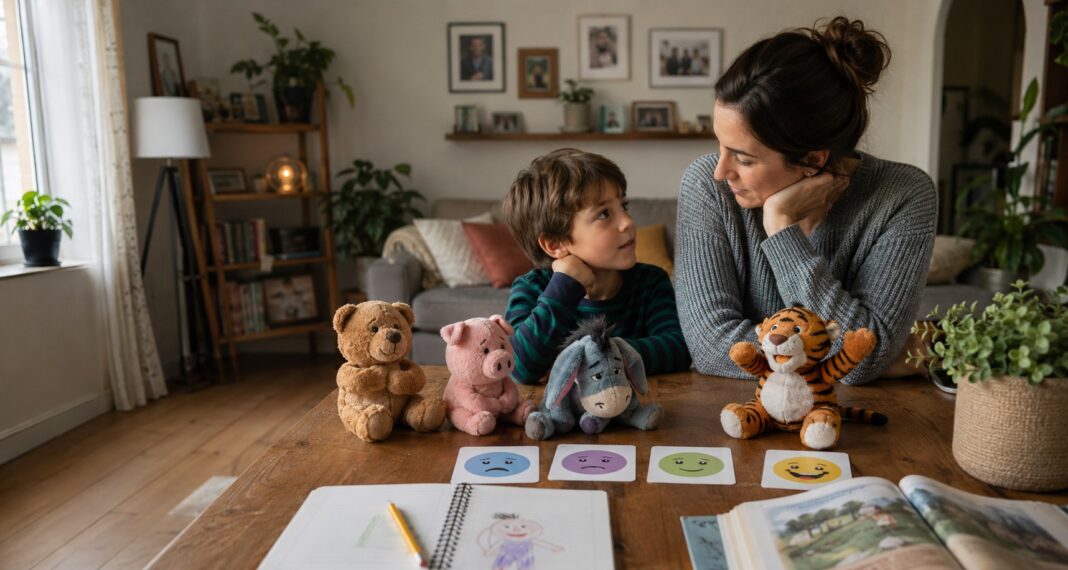
A bear forgets his plan. A small pig expects danger. A donkey sees the worst in nearly every situation. An energetic tiger acts before he thinks.
Those traits make the Winnie the Pooh mental illness theory easy to believe. Online charts often connect Pooh with ADHD, Piglet with anxiety, Eeyore with depression, and Tigger with hyperactive behavior. Other versions add OCD, autism, dyslexia, bipolar disorder, and schizophrenia.
The theory has a real source, but its online version has changed over time. The original article was a medical spoof published in 2000. It was not a clinical study, and A.A. Milne did not confirm that he created the characters to represent psychiatric conditions. Each character may remind readers of certain symptoms. That does not give any of them an official diagnosis.
Direct answer: Winnie the Pooh characters do not have confirmed mental illnesses. A humorous journal paper compared their fictional behavior with several disorders. Later websites expanded those comparisons and added claims that were not present in the original article.
Medical note: This article discusses fictional characters and a popular internet theory. It should not be used to diagnose a child, an adult, or yourself.
Before anyone diagnoses the Hundred Acre Wood
A personality trait and a mental health condition are not the same thing. Someone can feel nervous without having an anxiety disorder. A person can enjoy order without having OCD. High energy does not automatically mean ADHD. Sadness alone does not prove depression. A real diagnosis depends on a wider pattern. Health professionals consider how long symptoms last, where they appear, how severe they become, and how they affect daily life. Medical history, sleep, development, physical health, medication, stress, and family history may also matter.
Fictional stories rarely provide that level of information. Characters exist to move a story forward. Their habits may be exaggerated to make them funny, memorable, or easy to recognize. That is the first limit of the Pooh theory. It turns selected scenes into medical evidence, even though the stories were never written as patient records.
The chart shared online is not the original theory
A familiar social media chart gives one disorder to each character. It usually presents the list as if every connection came from the same medical source.
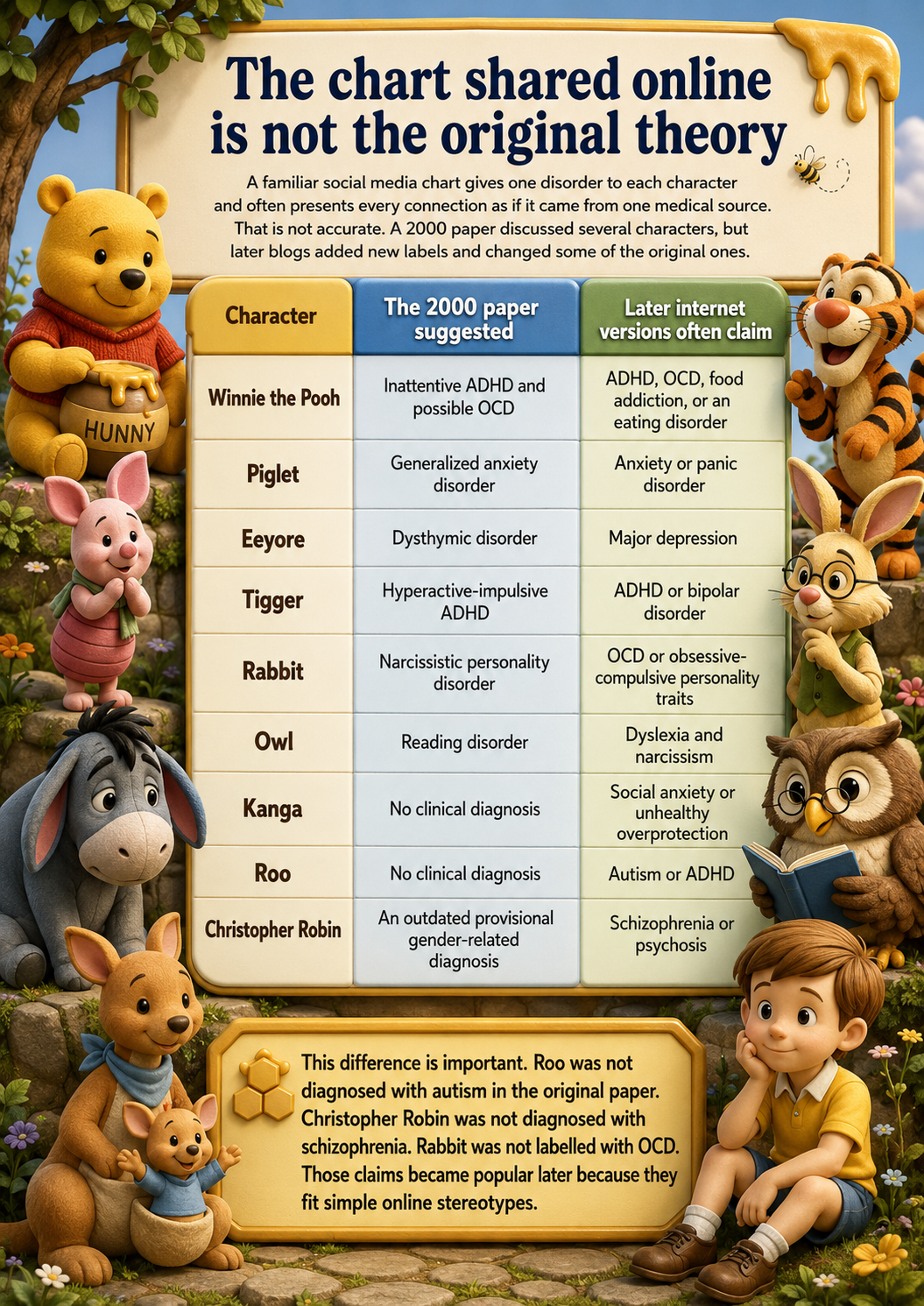
That is not accurate and 2000 paper discussed several characters, but later blogs added new labels and changed some of the original ones.
| Character | The 2000 paper suggested | Later internet versions often claim |
|---|---|---|
| Winnie the Pooh | Inattentive ADHD and possible OCD | ADHD, OCD, food addiction, or an eating disorder |
| Piglet | Generalized anxiety disorder | Anxiety or panic disorder |
| Eeyore | Dysthymic disorder | Major depression |
| Tigger | Hyperactive-impulsive ADHD | ADHD or bipolar disorder |
| Rabbit | Narcissistic personality disorder | OCD or obsessive-compulsive personality traits |
| Owl | Reading disorder | Dyslexia and narcissism |
| Kanga | No clinical diagnosis | Social anxiety or unhealthy overprotection |
| Roo | No clinical diagnosis | Autism or ADHD |
| Christopher Robin | An outdated provisional gender-related diagnosis | Schizophrenia or psychosis |
This difference is important. Roo was not diagnosed with autism in the original paper. Christopher Robin was not diagnosed with schizophrenia. Rabbit was not labelled with OCD. Those claims became popular later because they fit simple online stereotypes.
A holiday joke became an internet “fact”
The main source appeared on December 12, 2000, in the Canadian Medical Association Journal, often called CMAJ.
Its title was “Pathology in the Hundred Acre Wood: a neurodevelopmental perspective on A.A. Milne.”
Sarah E. Shea, Kevin Gordon, Ann Hawkins, Janet Kawchuk, and Donna Smith wrote the article. The authors worked in pediatrics and neurology at Dalhousie University in Halifax, Nova Scotia. They examined the characters through the diagnostic language used in DSM-IV, the fourth edition of the Diagnostic and Statistical Manual of Mental Disorders. Scenes from the Pooh stories became playful evidence for different diagnoses.
The article also discussed issues beyond mental health. It referred to Pooh’s diet, Eeyore’s missing tail, Owl’s damaged home, Kanga’s family situation, and the lack of adult supervision around Christopher Robin. That broad approach reveals the joke. The authors copied the style of a detailed medical case review and applied it to talking animals in a fictional forest.
CMAJ later described the piece as a spoof from its holiday issue. No patients took part. No interviews happened. No medical tests were completed. The authors did not conduct a controlled psychological study. The article gained international attention, and the joke slowly lost its original context. Short online summaries removed the satire. Social media charts then presented the labels as settled facts.
A Familiar Trait Is Not a Diagnosis
A character may show behavior that looks similar to a mental health symptom. That similarity alone does not confirm a disorder. Health professionals look at the full pattern. They consider how long the symptoms last, how severe they are, where they appear, and whether they affect school, work, relationships, or daily care. Sleep, stress, physical health, medication, and personal history can also explain the same behavior.
| A visible trait | What a real diagnosis requires |
|---|---|
| Forgetfulness or distraction | ADHD requires persistent symptoms that affect daily life in more than one setting |
| Sadness or low energy | Depression involves a wider group of symptoms that continue and cause impairment |
| High energy or impulsive behavior | ADHD cannot be confirmed from excitement or activity alone |
| Love of order and clean spaces | OCD involves intrusive thoughts, compulsions, distress, or loss of time |
| Frequent worry | An anxiety disorder involves fear that becomes hard to control and disrupts normal life |
| Spelling or reading mistakes | Dyslexia requires a proper assessment of reading and language skills |
| Imaginary friends or pretend play | Childhood imagination is not proof of schizophrenia or psychosis |
This difference matters throughout the Pooh Bear theory. Piglet’s fear may resemble anxiety, and Eeyore’s mood may look depressive. Tigger may seem impulsive, and Rabbit may appear rigid. These comparisons can help explain emotions, but they cannot replace a clinical assessment.
Have Questions About This Theory?
The HealthWavy AI Assistant can explain the Pooh Bear mental illness theory in simpler words. You can ask about a specific character, compare a personality trait with a real condition, or request a clear explanation of any part of this article.
Use chat or voice to ask your question. The assistant provides educational information and does not replace a diagnosis or advice from a qualified mental health professional.
Ask the HealthWavy AI AssistantPooh’s forgetfulness does not tell the whole story
Pooh often loses track of what he plans to do. He gets distracted, forgets details, and sometimes makes decisions without considering the result. The original paper linked these traits with inattentive ADHD. It also suggested possible OCD because Pooh repeats certain actions and thinks about honey so often. These comparisons sound simple, but both conditions involve far more than distraction or repeated habits.
ADHD is a lasting pattern of inattention, hyperactivity, impulsivity, or a combination of these traits. Symptoms must create real difficulty and usually appear in more than one setting. A proper assessment also looks for other possible causes, such as poor sleep, anxiety, depression, stress, or a physical health issue. Pooh’s stories do not give enough information about his development, daily impairment, or behavior across different settings.
His love of honey also gets overstated online. Some articles call it food addiction or an eating disorder. The stories do not show enough evidence to support either claim. Pooh likes honey because it is part of his character. The habit creates jokes, problems, and small adventures. That is not the same as proof of distress, loss of control, or a serious pattern that harms his health.
The label also hides his better qualities. Pooh is patient, kind, loyal, and unusually accepting of his friends. His mind may wander, but he often notices when someone needs company.
Piglet worries early and acts anyway
Piglet can imagine a problem before it appears. A strange sound, an uncertain plan, or a small risk may feel much larger to him than it does to the others. That behavior explains his connection with generalized anxiety disorder. The original CMAJ paper focused on his frequent fear and worry.
Piglet does resemble someone who feels anxious. He expects negative outcomes and finds uncertainty hard to manage. He may hesitate even when the situation appears safe. Still, ordinary fear has a purpose. It warns people about danger and helps them act with care. An anxiety disorder involves more than a nervous moment. The worry may stay present, feel difficult to control, spread across several parts of life, and interfere with sleep, school, work, relationships, or basic routines.
The stories cannot confirm those details and piglet also challenges the label attached to him. He does not wait until he feels fearless. He helps his friends even when he remains scared. That makes him a useful character for a different reason. He shows that courage can exist beside fear. A child does not need to feel calm before taking a safe and thoughtful action.
Eeyore’s sadness deserves more than a quick label
Eeyore expects disappointment. His voice sounds tired, his comments lean negative, and he sometimes assumes that others have forgotten him. Readers often connect him with depression. The original paper used the term dysthymic disorder, which older diagnostic systems used for a long-lasting depressive condition. Current medical language often uses persistent depressive disorder.
Eeyore may show traits linked with low mood. He lacks energy, expects plans to fail, and seems less excited than the rest of the group.
A few familiar behaviors still cannot establish depression. Major depression usually involves a group of symptoms that lasts for at least two weeks and affects ordinary life. Those symptoms may include loss of interest, sleep changes, appetite changes, poor concentration, guilt, low energy, or thoughts of death.
Persistent depressive disorder follows a longer pattern. The symptoms may be less intense than major depression, but they continue over an extended period. The Pooh stories do not offer a full clinical history. Readers cannot assess Eeyore’s sleep, appetite, physical health, concentration, or daily function from his gloomy remarks alone.
His friendships also matter. The other characters continue to invite him, visit his home, search for his tail, and make room for his mood. Eeyore does not need to become cheerful before he deserves friendship. That lesson has more value than treating him as a simple symbol of depression.
Tigger has energy to spare
Tigger moves quickly, talks with confidence, interrupts plans, and often jumps into situations before he considers the risk. His behavior led the original authors to suggest hyperactive-impulsive ADHD. This is one of the easier links for readers to recognize. ADHD can involve excessive movement, difficulty waiting, impulsive decisions, frequent interruption, and action without enough thought. Tigger displays several of those traits in an exaggerated way.
The problem begins when the comparison becomes a diagnosis. Plenty of children and adults are loud, active, excited, social, or spontaneous. ADHD requires a persistent pattern that causes meaningful difficulty. The symptoms must also appear across different parts of life rather than in one selected situation.
Tigger’s energy creates problems, but it also gives him confidence and enthusiasm. He wants to join activities and connect with others. He rarely hides at the edge of the group.
Calling him “the ADHD character” removes that balance. His stories work better as examples of impulse control, patience, personal space, and safe ways to use high energy.
Rabbit’s Need for Order Is Not Proof of OCD
Rabbit likes rules, schedules, and control. He protects his garden and becomes upset when others disrupt his plans. Later internet theories often label him with OCD, but the original 2000 paper linked him with narcissistic traits instead. OCD is not simply a love of neatness. It involves intrusive thoughts and repeated actions that a person feels driven to perform. These symptoms often cause distress and can take up a large part of daily life.
Rabbit’s behavior looks closer to rigidity, perfectionism, and a strong need for control. Even those traits do not confirm a personality disorder. His character simply shows how strict routines can create tension when there is little room for change.
Owl makes mistakes despite sounding certain
Owl speaks as if he has the answer. He gives long explanations, shares advice, and enjoys his place as the wise member of the group. He also misspells words and sometimes misunderstands written information.
The CMAJ paper linked those mistakes with a reading disorder. Later versions often use the word dyslexia. Dyslexia may affect accurate reading, fluent reading, spelling, word recognition, and the connection between letters and sounds. It does not mean a person lacks intelligence.
A proper assessment looks at several skills. It may examine reading speed, spelling, comprehension, memory, language, and educational history. Owl’s mistakes do not provide that evidence. They may exist because the author wanted a joke. They may also show a gap between confidence and real knowledge. Some online articles add narcissism because Owl likes to display what he knows. Confidence and pride alone cannot support that diagnosis either. Owl offers a simpler lesson: sounding certain does not always mean being correct.
Kanga and Roo Were Added to the Theory Later
The original 2000 paper did not diagnose Kanga or Roo with a mental health condition. It only described Kanga as a protective single parent who might become overprotective. Her concern for Roo does not prove anxiety. Later online charts linked Roo with autism or ADHD because he is energetic, curious, and sometimes unaware of danger. Those traits are common in young children and are not enough for either diagnosis. Autism involves lasting differences in social communication and behavior across several settings. Roo’s character does not provide that level of evidence. His diagnosis is a later internet claim, not part of the original theory.
Readers who want practical information beyond the fictional theory can read this guide to autism and daily health support.
Christopher Robin Does Not Show Proof of Schizophrenia
Some online posts claim Christopher Robin has schizophrenia because he talks to animals. The original CMAJ paper never made that diagnosis. The claim treats the animals as hallucinations, but they are real characters within the fictional world. They speak, make plans, solve problems, and interact with one another. Talking animals are part of the story, just like magic in a fairy tale.
Children may also talk to toys, create imaginary friends, and invent private worlds without having psychosis. Schizophrenia is a serious condition that requires a detailed professional assessment. Christopher Robin’s imagination does not provide medical evidence of it.
Some of the old language no longer belongs in modern health content
The 2000 article used DSM-IV, which reflected the diagnostic terms available at that time. Several names have changed since then. Dysthymic disorder is now generally discussed under persistent depressive disorder. Reading disorders receive more precise assessment. ADHD presentations have replaced some older subtype language.
The paper’s discussion of Christopher Robin also used a diagnosis and terms that modern health writers should handle with care. This does not mean the article must be erased from history. It means readers should understand when it was written and what its purpose was.
Medical language changes as research, clinical practice, and social understanding develop. A term from 2000 may not match current guidance in the United States. Repeating old labels without context can make an article inaccurate even when the original quotation is real.
The characters can still help families discuss emotions
The theory becomes more useful once the diagnoses are set aside. The characters give parents, teachers, and children familiar examples of different feelings and reactions.
Piglet can help start a conversation about fear. Eeyore can help explain sadness and inclusion. Tigger can show the need to pause before taking a risk. Rabbit can open a discussion about flexibility when plans change. Pooh can help children talk about distraction, patience, and listening.
Instead of asking a child which disorder a character has, adults can ask:
- How do you think Piglet feels here?
- What made Eeyore feel left out?
- How could Tigger slow down before he acts?
- What happens when Rabbit refuses to change his plan?
- Which character listens well?
- How could the friends make this situation easier?
These questions teach emotional awareness without turning a personality into a diagnosis. The stories also show that difficult traits can exist beside strengths.
Piglet worries, yet he can be brave. Eeyore feels low, yet he remains loyal. Tigger acts too quickly, yet he brings confidence and excitement. Rabbit becomes controlling, yet he works hard and cares about his home. Owl makes mistakes, but he still wants to help. Pooh forgets things, but he offers patience and kindness. That is a healthier message than assigning every character a disorder.
Simple labels can create false ideas about real conditions
The theory may seem harmless because it concerns fictional animals. Its stereotypes can still affect how readers treat real people. ADHD is not just loud behavior. Depression does not always look gloomy. OCD is not a love of clean rooms. Autism cannot be identified through innocence or high energy. Schizophrenia is not the same as an active imagination.

A person with anxiety may look calm. Someone with depression may laugh and remain socially active. A person with OCD may have compulsions that have nothing to do with cleaning. Simplified character labels can make genuine symptoms easier to dismiss. They can also encourage readers to diagnose friends, children, or themselves based on a small habit.
The original paper exaggerated behavior as part of a joke. Online posts often remove that clue. Once readers forget the satire, the labels begin to look like medical facts. That is where an entertaining theory becomes poor mental health education.
Pooh pathology quizzes should stay in the entertainment lane
Online tests often ask users a group of personality questions and match their answers with a Pooh character. A result may describe someone as Eeyore, Tigger, Piglet, Rabbit, or Pooh. The description can feel accurate because it uses broad emotions and habits that many users recognize.
Such quizzes cannot examine medical history, development, sleep, trauma, medication, family history, physical health, symptom duration, or daily impairment. They also cannot ask follow-up questions when an answer needs context. An Eeyore result does not prove depression. Matching with Tigger does not confirm ADHD. A Rabbit result cannot establish OCD.
The quiz may offer entertainment or a starting point for self-reflection. It should not guide treatment, medication, school support, or self-diagnosis. A person with genuine concerns should focus on real symptoms and their effect on daily life, not the name of a fictional character.
Real symptoms form a pattern
Health professionals do not diagnose a condition from one mood, habit, quote, or short video. ADHD symptoms must persist, affect life, and appear in more than one setting. Depression involves more than sadness and often includes several symptoms that continue for at least two weeks. OCD includes intrusive thoughts, compulsive actions, or both. Anxiety disorders involve fear or worry that becomes hard to control and disrupts normal life.
Professional support may be useful when symptoms:
- continue instead of easing,
- affect school or work,
- damage close relationships,
- disturb sleep or appetite,
- make routine tasks difficult,
- lead to unsafe choices,
- cause severe distress,
- or create thoughts of self-harm.
A doctor, psychologist, psychiatrist, or another qualified professional can look at the full situation. That process may also identify stress, sleep problems, medication effects, physical illness, or another cause. Seeking help is not an admission of failure. It is a practical step toward understanding what is happening.
Emotional pressure can also affect physical health. Our guide explains how ongoing stress affects the immune system over time.
The Hundred Acre Wood works better without diagnoses
The Pooh Bear mental illness theory started with a clever medical spoof in December 2000. It used real diagnostic language, but it did not report clinical research. The internet later turned its jokes into simple labels. It also added claims about autism, bipolar disorder, OCD, and schizophrenia that were not always part of the original article.
Pooh can remind readers of distraction. Piglet can reflect worry, Eeyore can represent low mood. Tigger can show impulsive energy and those similarities may help explain emotions, but they cannot confirm a disorder. The stronger message lies in how the characters live together. They irritate one another, misunderstand plans, feel afraid, lose confidence, and make poor choices. They also return, listen, forgive, and make room for different personalities. That is the part worth keeping. The Hundred Acre Wood is a useful place to talk about emotions and friendship. It is a poor place to hand out medical diagnoses.
HealthWavy Research Note
How We Checked This Information
This guide was prepared with input from four to five HealthWavy team members. We reviewed the original 2000 journal paper, checked later internet claims, and compared the medical details with recognized health authorities. The main source links appear inside the article so readers can review the evidence themselves.
We aim to keep every guide accurate and easy to understand. If you notice an unclear statement, outdated detail, or possible error, leave a comment below or email info@healthwavy.com . Our team will review your concern and update the page when needed.
Looking for a doctor or healthcare professional near you?
Visit the HealthWavy Doctor DirectoryQuestions Readers Often Ask
Winnie the Pooh is commonly linked with inattentive ADHD because he appears forgetful, distracted, and easily sidetracked. The original 2000 CMAJ paper also mentioned possible obsessive traits. These comparisons are fictional interpretations, not an official diagnosis. His behavior alone cannot confirm ADHD, OCD, or an eating disorder.
Piglet often worries about danger, expects problems, and feels nervous in uncertain situations. Those traits explain his link with generalized anxiety disorder. A real diagnosis requires symptoms that last, feel hard to control, and affect daily life. Piglet’s fear can also show courage because he still supports his friends.
Eeyore is often viewed as a symbol of depression because he shows low mood, little excitement, and a negative outlook. The original paper linked him with dysthymic disorder, now often called persistent depressive disorder. His fictional behavior resembles certain symptoms, but it does not provide enough evidence for a clinical diagnosis.
Tigger constant movement, quick decisions, interruptions, and risk-taking resemble traits linked with hyperactive-impulsive ADHD. High energy alone does not prove the condition. ADHD requires a lasting pattern that causes problems across more than one setting, such as school, work, home, or relationships.
Christopher Robin imaginary world does not prove schizophrenia. The original CMAJ paper never gave him that diagnosis. Later internet theories treated the talking animals as hallucinations, but they exist as real characters within the story. Children may also create imaginary friends and pretend worlds without showing psychosis.