


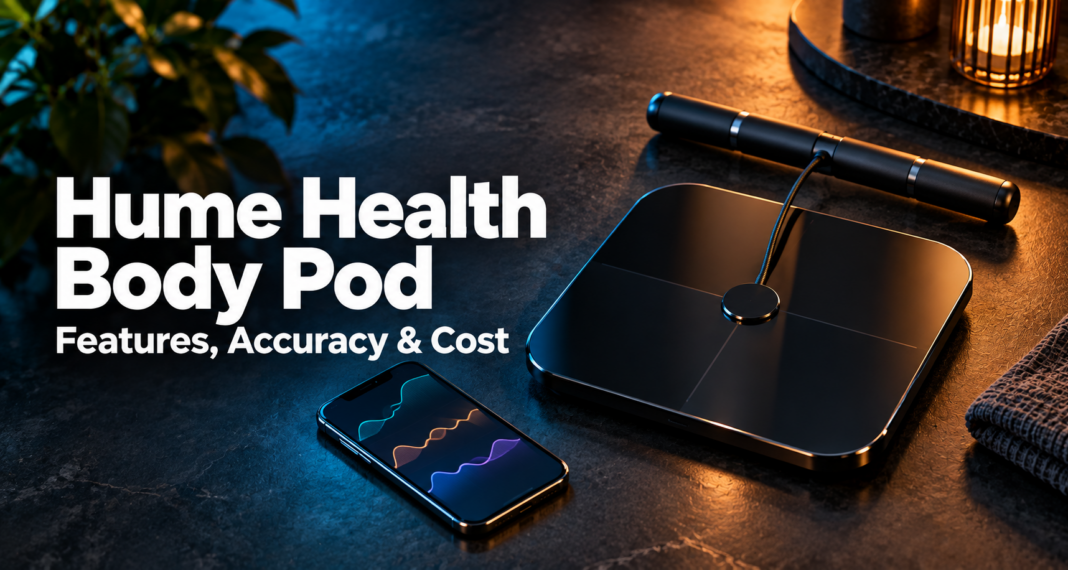
The Hume Health Body Pod is a smart scale that estimates body fat, muscle mass, body water, and other body composition measures. You stand on the scale and hold its sensor handle. The Hume Health app then shows your results and tracks changes over time. Its strongest use is to follow trends under consistent conditions. A single scan cannot tell you exactly how much fat or muscle you have, and it cannot replace a medical test.
That distinction matters if your weight stays the same even as your habits change. A regular scale gives you one number. The Body Pod offers more context, but each extra number needs careful interpretation. This guide explains what it measures, how reliable the results may be, and what to check before you buy.
The handle makes the difference
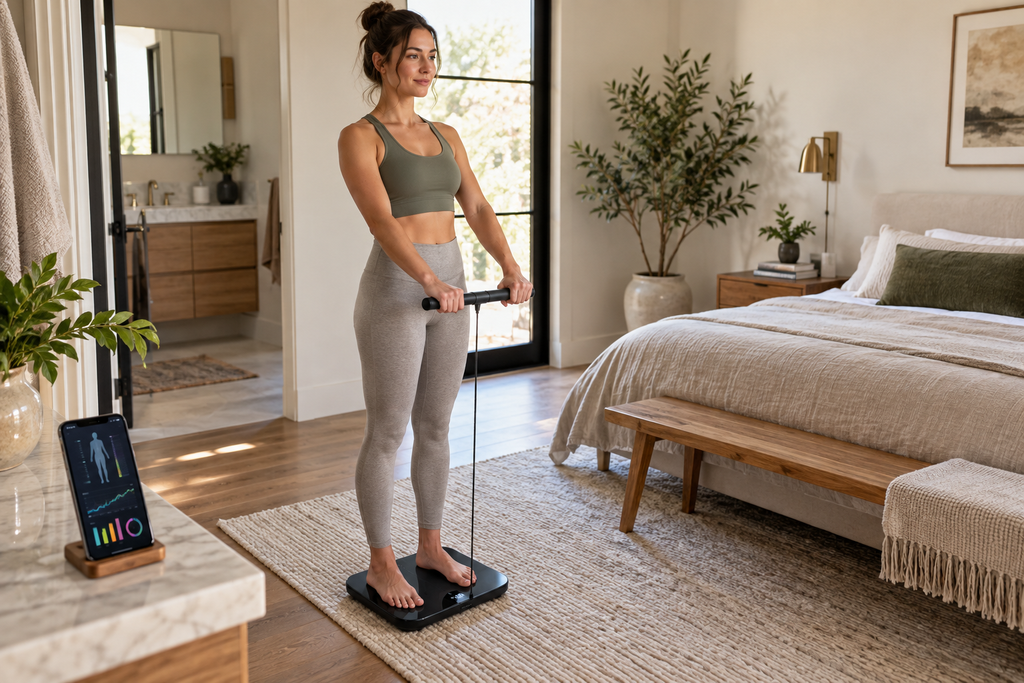
Many basic body composition scales collect information through sensors beneath your feet. The Hume Health Body Pod adds a handle with sensors for your hands. Hume says its eight electrodes collect information from the arms, legs, and torso, then use that information to estimate body composition for each area.
The method is called bioelectrical impedance analysis, or BIA. The device sends a small electrical current through the body and measures how the body resists it. Software uses that measurement, along with details such as your height, to estimate body water, fat, and lean tissue. The scale measures electrical resistance; it does not directly see fat or muscle. Hume’s own technical explanation describes its body composition results as estimates produced by prediction equations.
That does not make the results useless. It tells you how to use them. A steady change across several well-controlled scans may offer useful feedback. One surprising number after a workout, a large meal, or an unusually hot day deserves less attention.
Which numbers deserve your attention?
Hume advertises dozens of measurements, but most people will get the clearest picture from a small group of related results: body weight, body fat percentage, estimated fat mass, muscle or lean mass, and body water. The app also presents segmental results for different body areas and broader scores or metabolic measures.
Body fat percentage estimates the share of your total weight that consists of fat. Fat mass expresses that estimate as an amount of weight. If body weight drops, these figures may help you ask whether the change appears to involve fat, lean tissue, or water. They cannot settle that question from one scan.
Muscle and lean mass need similar care. If you want another way to explore the difference between body weight, fat, and lean mass, try Health Wavy’s lean body mass calculator.Its result is also an estimate, so do not expect it to match the Body Pod exactly. Lean mass includes more than muscle; water is a major part of it. A sudden rise in an app’s muscle estimate does not prove that you built new muscle overnight. A change in body water can affect the estimate.
Segmental results show estimates for areas such as each arm, each leg, and the torso. They may interest someone who follows strength training or recovery. Treat small differences between the left and right sides cautiously, especially if the difference appears only once. Hume notes that its estimates can have larger errors for people with unusual body proportions, significant swelling, or body compositions outside the populations used to develop its equations.
The app may also show visceral fat, metabolic age, bone-related measures, and heart-related insights. Those labels can sound more definite than the method allows. A home BIA scale cannot diagnose osteoporosis, measure bone density in the same way as a clinical DXA scan or establish whether you have a heart condition. If one of these results worries you, ask a qualified clinician which assessment fits your situation.
How accurate is the Hume Health Body Pod?
Hume promotes the Body Pod with claims about its agreement with DXA, a method often used as a reference in body composition research. A percentage such as “98% accuracy” may sound simple, but it does not tell a reader how closely every result for every individual will match a DXA scan. To judge an accuracy claim, you need to know which measurement researchers compared, who took part, and how much individual results differed.
There is also a difference between research on BIA as a method and a study of this specific product. General BIA research can explain the technology’s strengths and weaknesses. It cannot independently verify every claim made for the Hume Health Body Pod.
The US National Institutes of Health concluded that BIA can be useful for body composition analysis when major disturbances in body water are absent. It also identified several factors that affect results, including hydration, food and drink, recent physical activity, body position, and temperature. Those factors matter in a bathroom at home just as they do in a research setting.
The practical lesson is to value repeatable trends over precise-looking single readings. If your app reports a small change in body fat after one day, the number may reflect normal measurement variation. If a similar pattern persists over weeks under comparable conditions, it becomes more useful to discuss alongside your weight, strength, waist measurement, and how you feel.
A routine that makes the results more useful
You do not need to scan constantly to learn from the device. Choose a routine you can repeat. Use the scale at roughly the same time of day, under similar conditions, with bare feet and hands placed as the device directs. Avoid comparing a scan taken after intense exercise with one taken on a quiet morning.
Record what was different when a result seems unusual. A hard workout, travel, illness, or a change in food and fluid intake may explain a shift that otherwise looks like sudden fat or muscle change. This approach follows the NIH’s advice that reliable BIA measurements require consistent conditions.
One useful rule is to wait before you react. If the app shows an unexpected jump, take another measurement under your usual conditions on a later day. Do not change your diet or exercise plan because of one scan. The device becomes more helpful when it supports a longer view of your habits and progress.
The app is part of the purchase
The Hume Health app displays the Body Pod’s results and trends. Hume says users can access body composition measurements without paying for premium app features; it also offers optional paid features on some product pages. Check the current app terms during checkout, because offers and subscription details can change.
Think about whether you will use the extra detail. Someone who only wants a reliable record of body weight may find a simpler scale sufficient. Someone who follows a strength program, wants to watch longer-term body composition trends, and feels comfortable with estimates may get more value from the handle and app. That is a judgment about how the device fits your routine, not a claim that more displayed metrics automatically lead to better health decisions.
Price, returns, and details to check
The Body Pod is a higher-cost purchase than a basic weight scale. Hume’s product listing showed a price of $352 USD when checked in September 2026, but product pages and promotional pages may display different offers. Confirm the price at checkout, along with shipping, the return terms, the included warranty, and any optional app or warranty charges.
The purchase makes most sense if you expect to use the same device consistently for months. If you want a one-time answer about body composition, paying for a suitable professional assessment may serve that goal better. If you want frequent home estimates to help follow a fitness plan, the Body Pod offers a different kind of convenience.
When the results need extra caution
Body composition estimates may be harder to interpret during pregnancy, with significant swelling or fluid changes, and for people whose body proportions differ substantially from those used in the device’s prediction equations. Hume acknowledges that pregnancy-related water retention affects its readings and that some users may receive estimates with larger errors. Its FAQ also says its reference ranges for children have limitations.
If you have an implanted electronic medical device, such as a pacemaker, check with the clinician responsible for that device before using a scale’s electrical body composition feature. Hume’s FAQ states that some people with implanted devices can use the Pod, but advice for your particular device and medical history should come from your care team.
The Hume Health Body Pod is best understood as a home trend tool. It can add useful context to body weight, especially when you follow the same measurement routine. Its many results are estimates with different limits, so give the greatest weight to changes that persist over time and make sense alongside other signs of progress.