


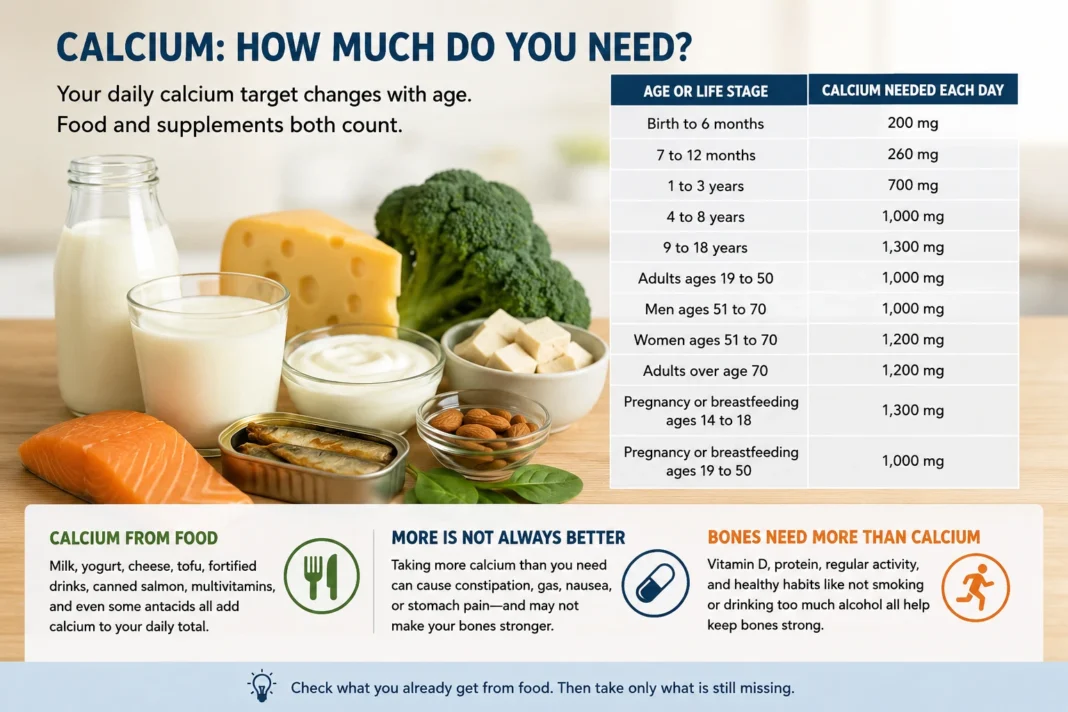
Calcium supplements for bone health help only when your diet falls short. If food already provides enough calcium, extra tablets may not strengthen your bones and can cause constipation, gas, or stomach discomfort. In addition, a supplement may form part of a care plan for weak bones. But the dose should fit your need, and it can also affect some medicines. So before you start, look at what you normally eat. You may need a small amount, or you may not need a supplement at all.
Calcium from food and tablets counts together
Before you buy a calcium supplement, check your food first. You may already get a good amount without realizing it. Milk, yogurt, cheese, tofu, fortified drinks, canned salmon, multivitamins, and even some antacids can all add calcium to your daily total.
An older woman may need around 1,200 mg a day. But maybe her food already gives her 800 mg. In that case, she is only short about 400 mg. Taking a full 1,200 mg tablet on top of that does not really make sense. More calcium does not always mean stronger bones. Instead, an unnecessary high dose may cause constipation, gas, nausea, or stomach pain.
So don’t choose the dose just because a big number is written on the bottle. First see what you already get from food. Then cover only the amount that is still missing.
Calcium does more than support your bones
Most of your body’s calcium is stored in your bones and teeth. That is where the body keeps its main supply. A little calcium also stays in the blood because your heart, muscles, and nerves need it.
The body does not like blood calcium to drop too low. So if you are not getting enough calcium from food, it may start taking some from the bones. You will not feel anything when this happens. There is no pain or clear warning. But if it keeps happening for years, the bones can slowly become weaker.
Your Calcium Target Changes With Age
The body does not need the same amount of calcium at every age. Babies need a small amount because their bodies are still tiny. Children need more as their bones get longer and stronger. In fact, calcium needs are highest during the teenage years. because a lot of bone growth happens during this time.
Most adults need around 1,000 mg of calcium each day. Women usually need more after age 50 because bone loss can speed up after menopause. Men normally move to the higher amount after age 70.
| Age or Life Stage | Calcium Needed Each Day |
|---|---|
| Birth to 6 months | 200 mg |
| 7 to 12 months | 260 mg |
| 1 to 3 years | 700 mg |
| 4 to 8 years | 1,000 mg |
| 9 to 18 years | 1,300 mg |
| Adults ages 19 to 50 | 1,000 mg |
| Men ages 51 to 70 | 1,000 mg |
| Women ages 51 to 70 | 1,200 mg |
| Adults over age 70 | 1,200 mg |
| Pregnancy or breastfeeding ages 14 to 18 | 1,300 mg |
| Pregnancy or breastfeeding ages 19 to 50 | 1,000 mg |
These numbers include calcium from everything you eat or drink. Milk, yogurt, cheese, fortified foods, multivitamins, antacids, and calcium tablets all count. It does not mean you should take the full amount as a supplement.
Your personal target may be different if you have kidney disease, osteoporosis, a parathyroid condition, or poor nutrient absorption. Ask a doctor or dietitian before starting a high-dose calcium supplement.
One day with little calcium will not cause weak bones. However, trouble can start when low intake becomes a regular habits over many months or years. More calcium is not always better either. Bones do not keep getting stronger each time you add another tablet. Once the body has enough, extra calcium may provide no further benefit.
Bone strength needs a different test
Doctors use a DXA scan to check bone density, usually at the hip and spine. A regular calcium blood test cannot do that. It may still look normal because the body can pull calcium from the bones to protect the blood level. Kidney problems, vitamin D, medicines, and parathyroid conditions can also affect the result. So a calcium dose should never be based on one blood test alone.
Food can cover a large part of your target
People often think they get very little calcium. A quick look at their meals may show a different picture. One cup of milk can provide close to 300 mg. Meanwhile, a serving of yogurt may provide around 400 mg. In addition, cheese or a fortified drink can raise the total quickly.
| Food | Approximate calcium |
|---|---|
| Plain low-fat yogurt, 8 ounces | About 400 mg |
| Milk, 1 cup | About 275 to 300 mg |
| Fortified soy milk, 1 cup | Often about 300 mg |
| Mozzarella cheese, 1.5 ounces | About 330 mg |
| Sardines with soft bones, 3 ounces | About 325 mg |
| Firm tofu made with calcium sulfate, half cup | About 250 mg |
| Canned salmon with bones, 3 ounces | About 180 mg |
| Cooked kale, 1 cup | About 90 mg |
The exact amount can change between brands and serving sizes. Read the Nutrition Facts label when you use fortified food. Plant milk needs extra attention. One brand may provide 300 mg per cup. However, another may contain very little calcium. Tofu also varies. For example, tofu made with calcium sulfate usually provides more calcium.
You can meet calcium needs without dairy
Milk, yogurt, and cheese make calcium easy to find. Still, they are not the only options. A dairy-free breakfast could include fortified soy milk and cereal. Lunch may include calcium-set tofu. Dinner may have beans, kale, bok choy, or canned fish with soft bones. Two cups of fortified soy milk may provide close to 600 mg.
Tofu and vegetables can add more. A vegan diet does not always need a calcium pill. However, it does require some care with food choices. People with lactose intolerance also have options. Lactose-free milk usually contains a similar amount of calcium to regular milk. Yogurt and hard cheese may feel easier on the stomach for some people. Do not assume your calcium intake is low just because you avoid regular milk. Check what you eat across a normal week.
Who may need calcium supplements for bone health
Calcium can become a problem in different ways Sometimes the issue is very simple. An older person starts eating less. Maybe breakfast gets smaller, dairy is no longer part of the day, and no other calcium food takes its place. It happens slowly, so the person may not notice anything has changed. Vegans, people with milk allergies, and anyone with a poor appetite can run into the same problem.
Then there are cases where the diet looks fine, but the body does not absorb calcium well. Celiac disease, bowel disease, or certain weight-loss surgeries can affect that. Menopause can also speed up bone loss. Steroid medicines, smoking, too much alcohol, low protein, and very little activity may make things worse.
Calcium supplements for bone health may be useful when food intake is low or the body does not absorb calcium well. They just do not solve every reason bones become weak. If bone loss is already there, proper treatment may be needed too.
Check your calcium gap over a few normal days
You do not need to record every meal for a month. Choose two or three normal days. Write down the main foods and drinks that contain calcium. Check each label and add the amounts. Compare the total with the target for your age.
Suppose you need 1,000 mg and your food gives you about 900 mg. That is a small shortage. One extra serving of yogurt or fortified milk may cover it. Now suppose your food gives you only 400 mg. That is a much larger gap. A better food plan, a supplement, or both may help. This small check can prevent a common mistake. People often buy a large dose before they know how much they need.
Choosing calcium supplements for bone health
The two most common calcium supplements for bone health are calcium carbonate and calcium citrate. Both provide calcium, but they work a little differently.
| Feature | Calcium carbonate | Calcium citrate |
|---|---|---|
| Elemental calcium | About 40% by weight | About 21% by weight |
| Best way to take it | With a meal | With or without food |
| Need for stomach acid | Higher | Lower |
| Number of tablets | Often fewer | Sometimes more |
| Stomach problems | More common | Often easier to tolerate |
| Cost | Usually lower | Often higher |
Calcium carbonate provides more elemental calcium in a smaller amount. As a result, it often costs less too. It needs stomach acid to dissolve well. Take it with a meal. Calcium citrate depends less on stomach acid. Therefore, it may suit older adults and people who take acid-reducing medicine and people who use acid-reducing medicine.
Citrate may also feel easier on the stomach if carbonate causes gas or constipation. Calcium citrate is not the best form for every person. It can cost more, and you may need extra tablets to get the same calcium dose. Your stomach, medicine use, budget, and daily routine can help you choose.
The number on the front may not show the true dose
A supplement bottle may show “1,250 mg calcium carbonate” in large print. That number can look like the amount of calcium in one tablet. It may not be. The Supplement Facts panel may show only 500 mg of calcium. The 500 mg figure is the elemental calcium amount. This is the number that counts toward your daily total.
Serving size can also cause confusion. A label may list 600 mg of calcium per serving. One serving may mean two tablets. One tablet would then provide 300 mg. Check every product you use. Multivitamins, antacids, meal replacement drinks, and protein shakes may contain calcium too. A person may think calcium comes from one tablet. In reality, it may come from several products used on the same day.
How to take calcium supplements for bone health
Your body usually absorbs calcium supplements for bone health better when each dose contains 500 mg or less. Absorption from supplements is highest when one dose contains 500 mg or less. A larger amount can still provide calcium. Even so, the body may absorb a smaller share of it.
Suppose you need 800 mg from supplements. You could take 400 mg with one meal and another 400 mg later. This may also reduce stomach trouble. A 1,000 mg tablet does not offer extra value when you only need 300 mg. The larger dose may increase side effects without helping your bones. Use enough to fill the shortage. There is no prize for the highest dose.
The best time depends on the type and your medicines
Calcium does not have one perfect time of day. Calcium carbonate should go with food. Breakfast, lunch, or dinner can all work. Calcium citrate can go with or without food. A meal may still help if your stomach feels sensitive.
Your medicine schedule matters more than the clock. Someone who uses thyroid medicine in the morning may need to take calcium later. Another person may have a night medicine that also needs space from calcium. Choose a time that fits your day and does not affect your medicine.
Vitamin D helps the body absorb calcium
Vitamin D helps the intestines take calcium from food. Low vitamin D can make it harder for your body to use the calcium you eat. Adults from age 19 to 70 generally need 600 international units of vitamin D each day. Adults over 70 generally need 800 international units.
Food, fortified products, sunlight, and supplements can all provide vitamin D. A combined calcium and vitamin D tablet may suit some people. Check your other supplements first. A multivitamin may already contain vitamin D. Because of this, another product could raise your total dose without you noticing.
A doctor may suggest a vitamin D blood test if deficiency seems likely. High-dose vitamin D should not become part of your routine without a clear reason.
Strong bones also need movement and protein
Calcium cannot protect your bones on its own. Walking, stair use, dance, and resistance exercise place healthy force on bone. This helps the body maintain bone tissue. Muscles matter too. Strong legs and better balance can reduce the chance of a fall. Protein forms part of the structure inside bone. A diet with enough calcium but very little protein still leaves a gap in bone care.

People with severe osteoporosis, spinal fractures, or poor balance need a safe exercise plan. A doctor or physical therapist can help choose suitable movements. It is also worth noting that reduced bone density increases the risk of stress fractures in the feet and lower limbs, particularly in people who maintain regular walking or exercise routines. Persistent foot pain during or after activity should not be dismissed as general soreness. Getting a proper evaluation through a dedicated stress fracture foot treatment service can help identify these injuries early before they progress into more serious damage.
A calcium pill cannot treat osteoporosis alone
Osteoporosis does not happen only because of low calcium. The condition makes bones weak and easier to break. Age, hormones, family history, health conditions, and medicines can all play a part.
Calcium supplements for bone health may support an osteoporosis care plan, especially when calcium intake is low. However, they do not replace prescription treatment when medicine is needed. Care may also include a bone density scan, resistance exercise, fall prevention, and a review of medicines that affect bone. Certain osteoporosis medicines slow bone loss. Other treatments help the body form new bone.
A calcium tablet cannot do those jobs. Do not stop prescribed osteoporosis medicine after you start a supplement.
CalciCan calcium supplements for bone health prevent fractures
Calcium supplements for bone health can correct a shortage, but they do not prevent every fracture. That does not mean a daily tablet will protect every person from a fracture. Research results differ because the people in the studies have different needs. An older adult with poor food intake and low vitamin D may benefit when those shortages improve. A healthy adult who already gets enough calcium may gain little from an extra tablet.
The U.S. Preventive Services Task Force found no net benefit from low-dose calcium plus vitamin D for the primary prevention of fractures in community-dwelling postmenopausal women. It also found that the evidence for higher doses was not clear. The final recommendation came out on April 17, 2018.
This advice does not cover every situation. Someone with osteoporosis, poor absorption, a previous fragility fracture, or low calcium intake needs personal medical advice. A supplement can correct a shortage. It cannot remove every cause of bone fracture.
Side effects of calcium supplements for bone health
Calcium supplements can cause constipation, gas, stomach pain, nausea, or a bloated feeling. Calcium carbonate tends to cause more stomach trouble than calcium citrate. A smaller dose may help. You can also divide the total across the day. Take calcium carbonate with a meal. Ask about calcium citrate if stomach trouble does not stop.
Extra water and more fiber may help with constipation unless your doctor has limited your fluid or fiber intake. Severe stomach pain, repeated vomiting, confusion, strong thirst, unusual weakness, frequent urination, or an irregular heartbeat needs medical care.
Too much calcium can cause harm
The upper daily limit is not a target. Adults aged 19 to 50 should generally stay below 2,500 mg per day from all sources. Adults aged 51 and older should generally stay below 2,000 mg per day.
Food, supplements, fortified drinks, multivitamins, and antacids all count toward these limits. Very high calcium intake may cause constipation, nausea, tiredness, kidney trouble, frequent urination, or heart rhythm problems. Severe high blood calcium often has another cause, such as cancer or a parathyroid condition. Normal food intake does not usually cause it in a healthy adult.
Kidney stones need careful advice
The link between calcium supplements and kidney stones is not simple. Some research found a higher stone risk with large supplement doses. Other reviews did not find the same result. Calcium from food may act in a different way. It can join with oxalate inside the gut. This may reduce the amount of oxalate that enters the urine.
Do not remove calcium-rich food just because you had a kidney stone. Stone type, salt intake, water intake, supplement dose, and meal timing can all affect risk. Ask a doctor whether you need a supplement and how to use it.
Heart risk is still not clear
Researchers have studied a possible link between calcium supplements and heart disease. The results do not all agree. Some studies raised concern about heart attacks or strokes. In contrast, other studies did not find a clear rise in risk.
This uncertainty gives you another reason to avoid a dose you do not need. Get as much calcium as you can from food. Use a supplement to cover a real shortage. People with heart disease, kidney disease, or several heart risk factors should discuss regular calcium use with a healthcare professional.
Calcium can affect your medicines
Calcium can join with some medicines inside the gut. This can reduce the amount of medicine your body absorbs. Levothyroxine is a common example. Calcium carbonate should stay at least four hours before or after levothyroxine. Certain antibiotics also need space from calcium.
Iron supplements can also be affected. Some osteoporosis medicines and HIV medicines have their own timing rules. Lithium may raise blood calcium and may need regular checks. Do not use one timing rule for every medicine. Ask a pharmacist to review the exact products you take.
Ignore big promises on the bottle
Words such as “maximum strength,” “bone rebuild,” and “complete bone support” do not prove that a product is better. Turn the bottle around and read the facts.
Check the elemental calcium amount. Look at the serving size and the type of calcium. Also check vitamin D, the expiration date, and the manufacturer details. Independent product tests can help confirm that the label is accurate. They cannot prove that the supplement will prevent a fracture. Avoid products that claim to cure osteoporosis. A supplement can support your diet, but it cannot replace medical treatment.
Your dose may not stay the same forever
Your calcium needs can change. You may add more calcium-rich foods to your diet.Your calcium needs can change over time. For example, you may add more calcium-rich foods to your diet or start a new medicine,may also change the advice. Review your supplement when your health, food, or medicines change.
A yearly review with a doctor or pharmacist can help, especially if you use several pills each day. Do not keep a high dose in your routine for years just because you once started it.
Get medical advice before you start
Talk to a healthcare professional before you use a calcium supplement if you have kidney disease, kidney stones, high blood calcium, a parathyroid condition, osteoporosis, heart disease, severe constipation, or poor nutrient absorption.
You also need advice if you had weight-loss surgery or use steroid medicine for a long time. Ask a pharmacist about calcium if you use thyroid medicine, iron, lithium, certain antibiotics, HIV medicine, or osteoporosis drugs. Children should not use an adult calcium product without proper advice. Pregnant and breastfeeding women should check the calcium in food and prenatal vitamins before they add another product.
Using calcium supplements for bone health safely
Check your daily calcium target. Estimate how much your meals already provide. Add only the amount that is missing. Keep one supplement dose at 500 mg or less when possible. Take calcium carbonate with food. Calcium citrate may feel easier on the stomach and may suit people with low stomach acid.
Check your medicines before you choose a time. Calcium supplements for bone health work best when they fill a real gap in your diet. They cannot replace food, vitamin D, protein, exercise, fall prevention, or osteoporosis care and this article offers general health information. It does not replace advice from a doctor, pharmacist, or registered dietitian. Ask a healthcare professional before you start a calcium supplement, especially if you have kidney disease, kidney stones, high blood calcium, osteoporosis, a parathyroid condition, or use regular medicine.
FAQs
Look at a normal day of food first. Milk, yogurt, cheese, tofu, and fortified drinks may already give you a fair amount. The supplement is only there for what is missing.
It can fix a low intake. It cannot control every reason bones break. Vitamin D, muscle strength, balance, exercise, falls, and osteoporosis treatment all matter too.
Fortified plant milk, calcium-set tofu, beans, kale, bok choy, sardines, and canned salmon with soft bones can all provide calcium. Check food labels because the amount may vary between brands.
Not on their own. They may help when calcium intake is low, but falls, weak muscles, low vitamin D, and osteoporosis can still lead to broken bone