


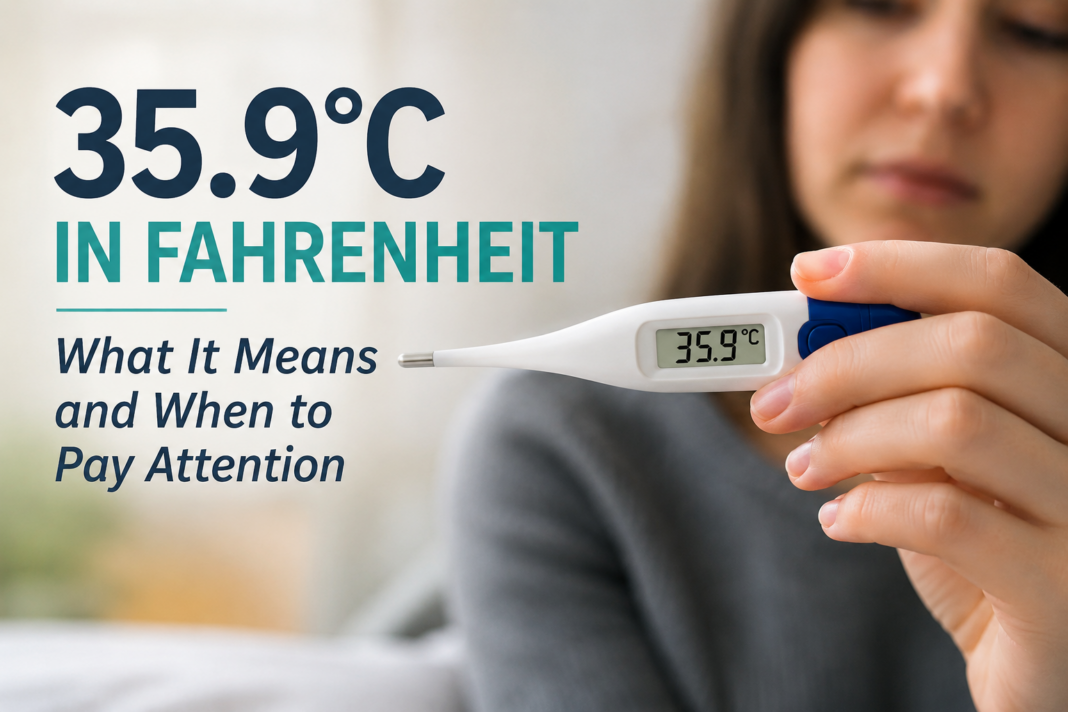
A thermometer that shows 35.9°C can look low, especially if you expect body temperature to sit close to 37°C. In Fahrenheit, 35.9°C equals 96.62°F.
If you came here for 35.9 C to F, 35.9 Celsius to Fahrenheit, or 35.9C to F, that is the direct conversion. If 35.9°C is your body temperature, the number needs a little more context. Age, thermometer method, time of day, and symptoms can all affect how you should read it.
| Celsius | Fahrenheit |
|---|---|
| 35.9°C | 96.62°F |
Getting 96.62°F From 35.9°C
Celsius converts to Fahrenheit with this formula:
°F = (°C × 9/5) + 32
Put 35.9 into the formula:
(35.9 × 9/5) + 32 = 96.62°F
That gives the same result whether 35.9°C appears on a body thermometer, weather display, kitchen thermometer, or another temperature device.
In simple terms:
35.9°C = 96.62°F
Is 35.9 C Normal or a Little Low?
A 35.9°C body temperature can be low for some people, but it does not automatically mean there is a medical problem. Body temperature naturally moves up and down. Your age, activity, time of day, and measurement method can change the number you see.
Cleveland Clinic gives a typical temperature range of about 36.4°C to 37.6°C (97.6°F to 99.6°F) for people ages 11 to 65. It also lists a lower typical range of about 35.8°C to 36.9°C (96.4°F to 98.5°F) for adults over 65.
That difference matters. A 35.9°C reading may be more unusual for one person than for another. Your usual temperature also gives useful context. Someone who normally sits around 36°C may view 35.9°C differently from someone whose usual readings are closer to 37°C.
96.62°F Is Not a Fever
A 96.62°F body temperature is far below the common fever level of 100.4°F (38°C) used for an oral temperature.
So, 35.9°C does not indicate a fever. People sometimes become concerned for the opposite reason and wonder whether 96.62°F means hypothermia. A single reading of 35.9°C is still above the usual hypothermia cutoff. Mayo Clinic defines hypothermia as a core body temperature below 35°C (95°F).
That means:
- 35.9°C = 96.62°F
- 35°C = 95°F
- 35.9°C is above the standard hypothermia threshold
A low reading should still get your attention if it keeps dropping, is very unusual for you, or appears with concerning symptoms.
Where You Check Your Temperature Changes the Reading
A thermometer does not always give the same number at every measurement site. A reading from your armpit can differ from one taken in your mouth, ear, forehead, or rectum. This is one reason a 35.9 temperature should not be judged from the number alone.
Common measurement sites include:
- Mouth
- Armpit
- Ear
- Forehead
- Rectum
Cleveland Clinic reports an average adult armpit temperature range of about 35.01°C to 36.93°C (95°F to 98.47°F). It also notes that oral temperature may provide a more accurate reading when that method is suitable.
A 35.9°C armpit reading, therefore, does not carry exactly the same meaning as a 35.9°C core temperature. Thermometer technique matters too. Poor placement, removing the thermometer too soon, or using a device incorrectly can give a result that does not reflect your actual body temperature.
A Second Reading Can Clear Up Doubt
One unexpected number does not always tell you much. Check again if 35.9°C looks unusual compared with your normal readings. Follow the thermometer instructions closely and use the same measurement site when possible so the two results are easier to compare.
Pay attention to how you feel at the same time. Someone who feels normal and gets one 35.9°C reading is in a different situation from someone who has a low temperature along with confusion, severe weakness, unusual sleepiness, or trouble speaking clearly. Repeated readings are often more useful than one isolated result.
Low Temperature With Symptoms Deserves More Attention
Cold exposure can also lower body temperature. If you use cold-water therapy, our ice bath safety guide explains temperature ranges, warning signs, and when to get out of the water.
Mayo Clinic lists symptoms of hypothermia that can include:
- Strong or persistent shivering
- Confusion
- Slurred speech
- Poor coordination
- Unusual drowsiness
- Slow or shallow breathing
- Loss of consciousness
A core body temperature below 35°C (95°F) is considered a medical emergency because it can indicate hypothermia. Urgent medical care is especially important when a very low reading appears with confusion, breathing changes, loss of consciousness, or other severe symptoms. A reading of 35.9°C by itself does not meet that standard hypothermia threshold, but symptoms and repeat temperature checks still matter.
Nearby Readings in Fahrenheit
Thermometers often move by a few tenths of a degree. This table can help if your result is close to 35.9°C.
| Celsius | Fahrenheit |
|---|---|
| 35.5°C | 95.9°F |
| 35.6°C | 96.08°F |
| 35.7°C | 96.26°F |
| 35.8°C | 96.44°F |
| 35.9°C | 96.62°F |
| 36.0°C | 96.8°F |
| 36.1°C | 96.98°F |
| 36.2°C | 97.16°F |
A change from 35.8°C to 35.9°C may look important on the display, but a few tenths of a degree should not be judged alone. Your normal temperature, age, symptoms, thermometer type, measurement site, and repeat readings give the number much more meaning.
Live 35.9 C to F Converter
Need to check another temperature? Enter any Celsius value in the converter below to get its Fahrenheit equivalent instantly. You can use decimals such as 35.9°C, 36.5°C, or 37°C as well as whole numbers.
Celsius to Fahrenheit Converter
Enter a Celsius temperature to see the Fahrenheit value instantly.
The result updates as you enter a temperature, so you do not need to calculate the formula yourself.
Changes in skin color, sensation, or hand temperature can also give useful clues about circulation. Our gaming sleeve health guide explains when these changes may deserve more attention.