

A legal blog can sound useful until a real health problem lands in your lap. A patient cannot get a copy of lab results. A hospital portal shows the wrong diagnosis. A health app shares sensitive data. A family member wants access to records after an emergency. Someone reads one legal article online and suddenly feels sure they know the answer.
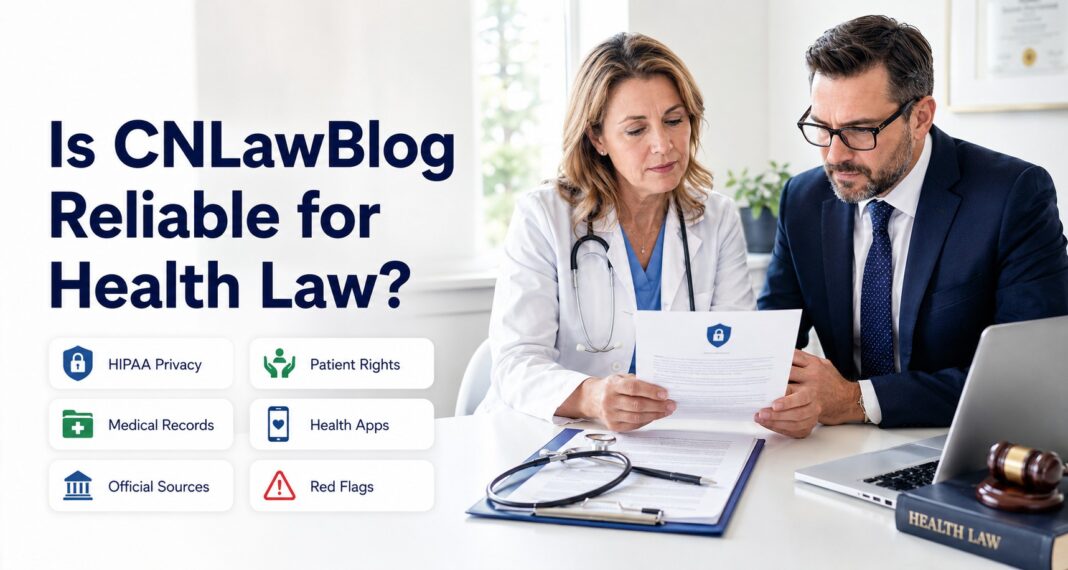
That is the dangerous part. CNLawBlog may help readers understand legal topics in a simple way, but health law needs more care than a normal legal explainer. Medical privacy, patient records, app data, consent, and patient rights all sit in a sensitive space. A broad legal article can give background. It should not decide the next move for a patient.
The better question is not whether CNLawBlog is “good” or “bad.” A smarter question is whether a specific CN Law Blog page gives enough proof, context, and limits to help with a health-law issue in the United States. Most readers do not need legal theory. They need to know when a source is safe to read, when it is too general, and when official help is the only sensible option.
The real issue is not the blog name
CNLawBlog appears as a legal content platform that covers general legal topics such as corporate law, civil law, criminal law, law updates, and case studies. That type of content can be useful for general legal awareness. Health law works differently. A reader who wants help with patient records, HIPAA, medical privacy, or health app data needs more than a simple legal overview. The article must tell the reader which law applies, which country it covers, and which agency handles the issue.
That is where confusion can start. The name CNLaw Blog can point readers toward legal content, but it does not automatically prove that a page is strong enough for U.S. health-law questions. Some online pages that use similar wording discuss China law. Some discuss general legal education. Some review the platform itself. Some speak in broad terms without deep proof.
A reader should not assume all “law blog” content applies to a medical privacy problem in the U.S.
Legal content needs a location. Health law needs even more location and a patient in Florida, a clinic in Texas, a health app based in California, and a hospital system in New York can all face different rules in some situations. Federal law may apply, but state laws can also affect privacy, minors, mental health records, reproductive health data, billing disputes, and complaint options.
A blog that does not explain that limit may still be readable, but it is not enough for action.
Health law does not reward vague answers
A weak health-law article often says the same safe lines.
- Patients have rights.
- Privacy is important.
- HIPAA protects medical data.
- Seek legal advice if needed.
Those lines are not wrong, but they are not enough.
A useful article should explain what those rights mean in daily life. It should also explain what they do not mean. That second part matters more than many readers expect. HIPAA does not cover every business that collects health-like information. A fitness tracker may hold sensitive data but may not work like a hospital under HIPAA. A wellness app may know more about someone’s habits than a clinic does, yet a different law or complaint path may apply. A search engine, ad platform, wearable device, or symptom-checking site can create privacy issues outside the usual doctor-patient setting.
A health-law guide earns trust when it slows down and separates these situations. It should not treat every piece of health data as the same.
A reliable source should answer practical questions:
- Who has the data?
- Is it a doctor, hospital, pharmacy, insurer, app, employer, school, or website?
- Did the patient give written permission?
- Was the data shared for treatment, payment, operations, marketing, safety, public health, or another reason?
- Does HIPAA apply, or does another privacy rule matter more?
- Which office can receive a complaint?
CNLawBlog can help if it frames questions this way. It becomes risky if it gives broad legal statements without these details.
A quick way to test any CNLawBlog health article
A reader does not need to be a lawyer to check whether an article deserves trust. A few simple checks can expose weak content fast. Look at the author first. A health-law page should not hide behind a generic name if it gives serious guidance. A named attorney, health privacy professional, compliance expert, or trained health writer adds more trust. A generic admin name does not automatically make the content false, but it gives the reader less reason to rely on it.
Check the date next. Medical privacy rules, app privacy rules, and digital health rules change. An old article may still explain basic HIPAA ideas, but it may miss newer issues around patient portals, app data, data brokers, or connected devices. Read the page for jurisdiction. The article should tell you whether it discusses U.S. law, China law, UK law, EU privacy law, or general legal ideas. A page that jumps between systems without clear labels can confuse readers.
Scan for official sources. Health-law content should refer to official bodies such as HHS, the Office for Civil Rights, ONC, FTC, CMS, state health departments, or court records when relevant. A page that cites only other blogs has weaker support. Notice the tone. A safe legal article does not promise results. It does not tell every reader to file a case. It does not turn a complex privacy issue into a one-line answer. Strong legal writing admits limits.
That last point matters. Trustworthy guidance sounds careful. Weak guidance often sounds too confident.
Where CN Law Blog can help a health reader
CN LawBlog can still serve a purpose. Not every reader needs an attorney-level answer. Some readers only want to understand the basic shape of a topic before they move to official sources.
It may help with:
- basic legal terms
- general legal education
- early research before deeper verification
- comparison between different legal topics
- simple background on how legal blogs present information
- awareness of legal categories such as civil law or corporate law
That type of use is safe if the reader treats it as a starting point.
A patient might read a CNLawBlog article to understand what “privacy rights” means in broad terms. A student might use it to compare legal topics. A general reader might use it to build a list of questions before checking HHS or state guidance.
That is a fair use of a general legal blog. The problem starts when a reader uses one broad article as the final answer. A patient should not decide that a hospital broke the law based only on a general blog post. A person should not accuse an app of a privacy breach without checking whether the app falls under HIPAA, FTC rules, state law, or its own privacy promises. A family should not rely on a blog alone to decide who can access medical records after a serious illness or death.
A blog can open the door. Official sources and qualified advice should handle the serious part.
The HIPAA trap many readers miss
HIPAA gets used online as if it covers every health privacy problem. That creates bad assumptions. HIPAA generally applies to covered health care providers, health plans, health care clearinghouses, and business associates that handle protected health information for covered entities. That can include hospitals, doctors, clinics, dentists, pharmacies, health insurers, Medicare, Medicaid, and certain vendors that serve them.
That does not mean every health-related company follows HIPAA. A meditation app, diet app, step tracker, fertility tracker, wearable device, online quiz, health newsletter, or direct-to-consumer wellness platform may collect sensitive details. Some of those details may feel deeply medical. Still, HIPAA may not be the right legal path.
This is why health readers need careful wording. A blog post that says “your health data is protected by HIPAA” without explaining who holds the data can mislead people and better way to think about the issue is simple.
If the data sits with a doctor, hospital, pharmacy, insurer, or health plan, HIPAA may matter. If the data sits with a consumer app or wellness website, another rule may matter. In some cases, the FTC may care. State privacy laws may also matter. The company’s privacy policy may also become important. CN Law Blog can be useful if it explains this split. It is not reliable enough if it treats HIPAA as a blanket answer for every digital health problem.
Medical records are where readers need the clearest help
Record access looks simple on paper. In real life, it can become messy. A patient asks for records. The office says to use the portal. The portal does not show everything. The clinic says the request must go through a third-party records company. The patient gets only part of the file. The bill looks high. The response takes too long. Nobody explains the denial.
This is the type of issue where a general legal blog may feel helpful but still leave gaps. A stronger guide should tell readers what to do before the problem gets worse.
A patient should make the request in writing. The request should name the records needed, the date range, the preferred format, and the delivery method. A portal message can help. An email can help if the provider accepts it. A formal records request form can help. The patient should keep a copy of everything. A phone call may move the process faster, but it rarely creates a clean record. Written proof matters if the patient later contacts a privacy officer or files a complaint.
Readers should also know that record access does not always mean instant access to everything in every format. Some limits may apply. Providers may need time to process requests. Certain notes or records may have special rules. State law can add details. That is why a CN Law Blog article about patient records should never stop at “patients can access their records.” It should explain the steps, the timeline concerns, and the complaint path.
Readers who want a real example of how medical care standards, patient rights, and legal oversight can connect may also read our guide on healthcare lawsuits and patient rights .
Patient rights go beyond privacy forms
People often connect patient rights only with HIPAA and that is too narrow. Patient rights also touch consent, communication, safety, respect, billing clarity, language access, emergency care rules, disability accommodations, and the right to ask questions before treatment.
Consent deserves special care. A patient may sign a form during stress, pain, or fear. That form may cover treatment. Another form may cover records. Another may allow contact with family. Another may involve payment or insurance. Another may involve data use or communication through a portal.
A patient does not need to understand every legal term to ask good questions.
Useful questions include:
- What does this form allow?
- Is this required for treatment?
- Who can receive my information?
- Can I limit this permission?
- How long does this consent last?
- Can I get a copy before I sign?
- Can I revoke this later?
A reader-friendly health-law article should encourage those questions. It should not make patients feel foolish for asking. CNLawBlog can offer general education here, but it should point readers back to official patient-rights sources and the provider’s own privacy notice. A hospital’s Notice of Privacy Practices often gives key details about how records may be used, shared, corrected, and requested.
Digital health has changed the privacy question
Health privacy used to feel easier to place. The doctor had the chart. The insurer had the claim and the hospital had the records. Now health data moves through phones, watches, apps, portals, cloud systems, chat tools, payment platforms, ads, and third-party services. A person may share symptoms with an app before they ever speak to a doctor. A wearable may collect heart rate and sleep data every night. A wellness company may collect location, medication, pregnancy, diet, or mental health details.
This does not make every company a hospital. It does make privacy harder to judge. The FTC has placed more attention on health apps and similar technologies not covered by HIPAA. That matters because many readers wrongly assume a health app has the same privacy duties as a medical office.
A good guide should explain this in plain English. If a health app shares sensitive data without proper notice or consent, the issue may not fit the usual HIPAA path. Another consumer protection route may apply. The answer depends on the company, the data, the privacy promise, the type of breach, and the law in place.
A CNLawBlog page that ignores health apps is incomplete for modern medical privacy. A page that explains both HIPAA and non-HIPAA health data is far more useful.
China law content can confuse a US health reader
The “CN” in CNLawBlog can create another problem. Some readers may connect the name with China law. Other pages online discuss China Law Blog or China-focused legal content. That field can be useful, but it is not the same as U.S. patient rights. China-related legal content may cover business contracts, trade, foreign companies, intellectual property, labor law, or cross-border compliance. Those topics do not answer a U.S. patient’s HIPAA question.
A U.S. reader should pause if a page talks about Chinese regulations, international business, or foreign compliance without clear connection to U.S. health law. It may still be a good article for its own topic. It may not help with a medical privacy problem in Ohio, Texas, New York, California, or Florida. This distinction protects readers from a common search mistake. A page can rank for a legal term and still be the wrong source for the reader’s problem.
The safest path after reading a legal blog
A careful reader can use CN Law Blog as step one, then move to stronger sources. If the issue involves a hospital, clinic, pharmacy, doctor, dentist, health plan, or medical record, check HHS and the Office for Civil Rights. These sources explain HIPAA rights, privacy rules, record access, and complaint steps.
If the issue involves electronic health information, portal access, or possible blocking of records, check ONC resources on information blocking and patient access.
If the issue involves a health app, connected device, wearable, or consumer wellness tool, check FTC health privacy guidance. The privacy policy and terms of the app also matter.
If the issue involves Medicaid, Medicare, billing, insurance coverage, or plan disputes, CMS and state insurance departments may matter.
If the issue involves mental health records, minors, reproductive health data, substance use treatment records, HIV status, or state-specific privacy protections, state law may change the answer.
A reader should contact the provider’s privacy officer when the issue comes from a medical provider. Large hospitals usually list privacy contact details in their Notice of Privacy Practices. Smaller clinics may still have a privacy contact or records department.
A lawyer becomes more important if the issue involves financial harm, identity theft, denied treatment, job consequences, insurance denial, a lawsuit threat, or a serious privacy breach.
Official HIPAA Privacy Rule Document
Readers who want to check the official privacy rule in more detail can review the Summary of the HIPAA Privacy Rule PDF published by the U.S. Department of Health and Human Services.
Red flags that should make a reader stop
Some warning signs do not require legal training.
A CNLawBlog page should not be treated as enough if it has several of these problems:
- no named author
- no clear update date
- no country or state context
- no official health-law sources
- no difference between HIPAA and app privacy
- no mention of HHS, OCR, ONC, FTC, CMS, or state agencies when relevant
- no clear disclaimer
- broad promises about legal outcomes
- heavy guest-post style with thin facts
- general law content placed under a health topic without real health-law detail
One weak sign may not ruin a page and several weak signs mean the reader should not use it for action. The biggest red flag is certainty without facts. Health-law answers depend on details. A page that says “this is illegal” without explaining who did what, which law applies, and which source supports the claim is not strong guidance.
A more honest answer about reliability
CN Law Blog can be reliable for simple legal awareness when the page has clear authorship, current dates, careful wording, and useful references. It can help readers learn basic ideas before deeper research. It is not enough on its own for health law, medical privacy, or patient rights in the United States.
That does not make it useless. It means readers should use it in the right place. Treat it like a map of the area, not the final legal route. A map can show direction, but it cannot tell every patient what to do with a denied record request, a possible HIPAA issue, or a health app privacy concern. A safe reader should move from blog content to official sources before taking action. That step matters even more when the issue involves treatment, records, insurance, identity, family access, or sensitive health data.
The most helpful use of CNLawBlog is not to get a final answer. It is to learn what questions to ask next.
Editorial Note
This information was carefully researched and reviewed by our writer experts before publication. The details shared in this guide are based on verified sources, official references, and publicly available information at the time of writing.
Health and legal information can change over time. If you notice anything that needs correction or an update, please let us know in the comments or contact us at info@healthwavy.com.
Small Questions That Can Prevent Big Mistakes
Should readers rely on CNLawBlog for health law issues?
CNLawBlog may help someone understand the basic idea behind a legal topic. It should not guide a final health-law decision on its own. Medical privacy, patient records, and health rights need support from official sources such as HHS, OCR, ONC, FTC, or a state health agency.
Is CNLawBlog enough for learning HIPAA privacy rules?
A simple CNLawBlog article may explain HIPAA in plain language, but readers should still confirm the details through HHS. That step matters before a person files a complaint, asks for medical records, or claims that a provider shared private health information in the wrong way.
Do health apps always fall under HIPAA?
HIPAA does not protect every fitness app, wellness website, period tracker, symptom checker, or health tool. Some apps collect sensitive health details but follow different privacy rules. FTC guidance, state privacy laws, and the app’s own privacy policy may matter more in those cases.
How can I tell if a CNLawBlog article deserves trust?
A useful article should show who wrote it, when it was updated, which country’s law it covers, and which official sources support the claims. Strong health-law content also explains limits. It does not make broad promises or treat every patient case the same.
Can CNLawBlog take the place of a doctor or lawyer?
CNLawBlog can support early research only. A real medical or legal problem needs advice based on the person’s facts, records, location, and risk. A doctor, lawyer, privacy officer, or official agency can give guidance that a general blog cannot provide.
Where should someone start after a medical privacy problem?
The provider’s privacy office is often the first place to contact when the issue involves a doctor, clinic, hospital, pharmacy, or health insurer. A serious concern may also need an HHS OCR complaint or help from a qualified legal professional.