


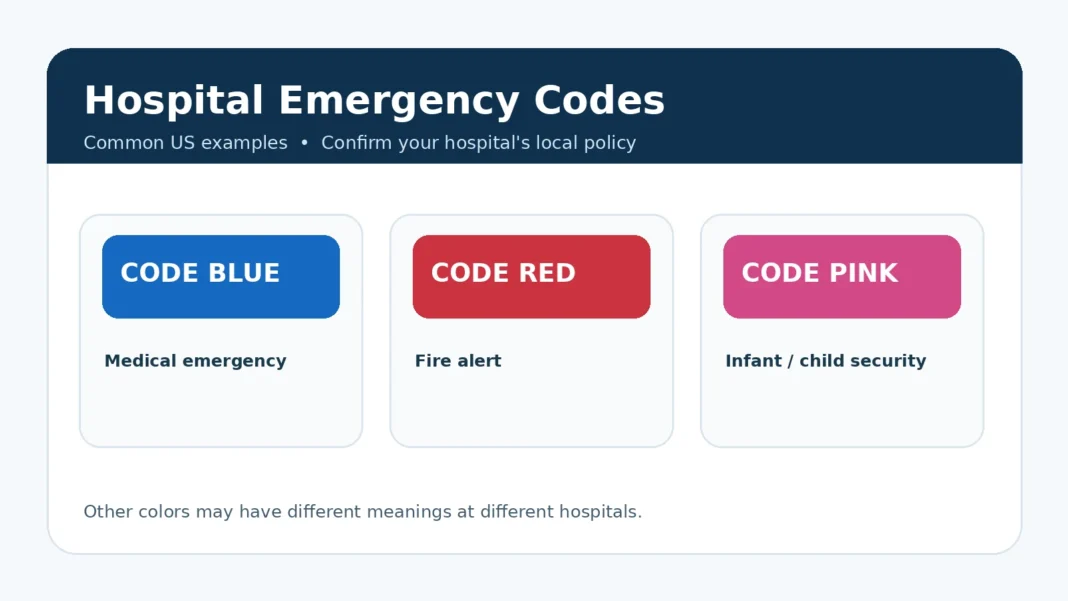
Hospital color codes are short emergency alerts. In many US hospitals, Code Blue signals a medical emergency, Code Red means fire, and Code Pink concerns an infant or child security emergency. Other colors vary by hospital, state and health system.
There is no single nationwide list that safely explains every code. Patients and visitors should follow staff instructions and the hospital’s own emergency procedures rather than assume a color has the same meaning everywhere.
A quick look at common codes
Hospitals historically used short announcements so trained staff could respond quickly without a long explanation over loudspeakers. The familiar colors remain useful in many facilities, but the exact response instructions are local.
| Code | Often signals | Important detail |
|---|---|---|
| Blue | Cardiac or other critical medical emergency | Response team and location announced |
| Red | Fire or smoke | Follow fire response and evacuation guidance |
| Pink | Infant or child abduction/security | Some facilities use different labels |
| Silver | Weapon or armed threat in some hospitals | Meaning can differ across facilities |
| Orange | Hazardous material in some systems | May refer to a different incident locally |
California hospital-association guidance and state-level policies illustrate how codes can be assigned. The table is a reference for understanding announcements, not an instruction manual for emergency responders.
Code Blue means urgent medical help
Code Blue is commonly used when a patient has a cardiac or respiratory arrest or another life-threatening medical emergency. A specially trained response team may arrive with resuscitation equipment.
Visitors should not move toward a Code Blue location to watch. Keep corridors clear and follow the directions of nurses, security or hospital staff. The announcement itself does not confirm an individual patient’s diagnosis or outcome.
Some hospitals clarify whether a Code Blue involves an adult or a child. Others use plain words such as “medical emergency” alongside the location.
Code Red usually warns of fire
Code Red commonly describes a fire or smoke emergency. Staff may close doors, move equipment or redirect people through safe corridors as part of the hospital’s fire-response plan.
Do not use elevators during a fire evacuation unless authorized by staff or an emergency plan. Hospitals contain people who may need assistance moving, so staff often direct evacuations in stages rather than asking everyone to rush outside.
Not every red announcement means the entire building must evacuate. Pay attention to the exact location and instructions given over the hospital’s system.
Code Pink concerns child security
Code Pink is widely associated with a missing or abducted infant or child. A security response can involve checking exits, looking at identification and asking visitors to remain in specific areas.
A person who hears the alert should follow local instructions, not attempt to stop strangers on their own. Report genuinely relevant information to hospital security without creating a confrontation.
Color names are not perfectly consistent. Some hospitals have replaced Code Pink with a plain-language alert that tells people exactly what has happened.
Other colors need local context
Silver, yellow, orange, black, white, purple and green appear in different emergency systems. Their definitions are less consistent across hospitals. A color may describe a security threat in one facility and a weather or hazardous-material incident in another.
For example, a hospital may use Code Silver for an armed person, but another facility may announce the same situation in plain language. Reading a general list online cannot establish your hospital’s procedures.
Staff members should use their employer’s official emergency response guidance and current training materials. Patients and visitors should ask personnel what an announcement means if they are unsure.
A real hospital badge shows why codes differ
This historical employee badge from William Beaumont Hospital in Troy, Michigan shows a set of facility-specific disaster codes. It is an example of how hospitals have communicated emergency instructions to staff, not a current policy for that hospital.

A badge like this helps workers remember the correct response inside one facility. It also explains why national lists can confuse patients when a hospital uses different names.
Hospitals are moving toward plain language
Some health systems now announce “fire in the west wing” or “security emergency” instead of relying on a secret color. Plain wording can help employees, patients and emergency services understand the event immediately.
The Hospital Association of Southern California has supported a transition toward plain-language emergency alerts, with Code Blue retained in its approach. Washington hospitals have likewise promoted clearer announcements for many types of emergencies. Washington State Hospital Association guidance describes this transition.
Plain-language alerts do not remove the need for trained responders. They change the announcement so people can recognize the situation and act according to the hospital’s plan.
What patients and visitors should do
A code announcement is mainly directed to hospital personnel. Visitors do not need to memorize every color, but they should avoid blocking doors, elevators or emergency equipment.
- Listen for directions about the affected location.
- Stay clear of corridors needed by response teams.
- Follow nurses, security staff and posted instructions.
- Do not share unverified details about a patient’s condition.
- Ask staff for guidance if you are uncertain where to go.
If you are in immediate danger, alert staff at once. A medical emergency or security threat should not wait while you look up the meaning of a color on your phone.
Planning ahead can reduce confusion
Hospitals frequently run drills so employees know how to respond to fires, missing children, severe weather and other threats. Each role has different responsibilities, and emergency plans need to account for patients who cannot move independently.
People visiting a hospital for scheduled care can ask where emergency exits are and whom to contact if assistance is needed. HealthWavy’s doctor-finding page can help with ordinary care searches, but it is not an emergency-response service.
Hospital administrators should maintain clear training, consistent signage and communication for workers who rotate across facilities. Staff must follow the policy used at their own institution, even if an online chart suggests a different code.
Are hospital codes the same worldwide?
Countries and individual health systems may follow different standards. The US examples above should not be assumed to apply in the United Kingdom, India, Australia, Pakistan or elsewhere.
Some countries rely more heavily on spoken plain-language instructions, while others retain color-coded alerts. A traveler should follow local hospital signs and personnel rather than use a code chart written for another country.
Questions about hospital color codes
Does Code Blue always mean someone died?
It signals an urgent medical response, not an outcome. A Code Blue may be announced when a team needs to assess and treat a life-threatening emergency.
Is Code Black always a bomb threat?
No. Code Black has different definitions across hospitals. Ask local staff or check the hospital’s current emergency policy.
Does Code Red always require evacuation?
A fire alert may affect only part of a hospital. Follow local instructions instead of assuming the whole building must be evacuated immediately.
Who decides which colors are used?
Hospital leadership, local health systems and applicable state regulations influence the codes. Some facilities now prefer plain-language alerts.
If you hear an unfamiliar color code, the safest action is to pay attention to staff instructions and the affected location. Color lists are useful background, but the hospital’s current emergency plan controls the response.