


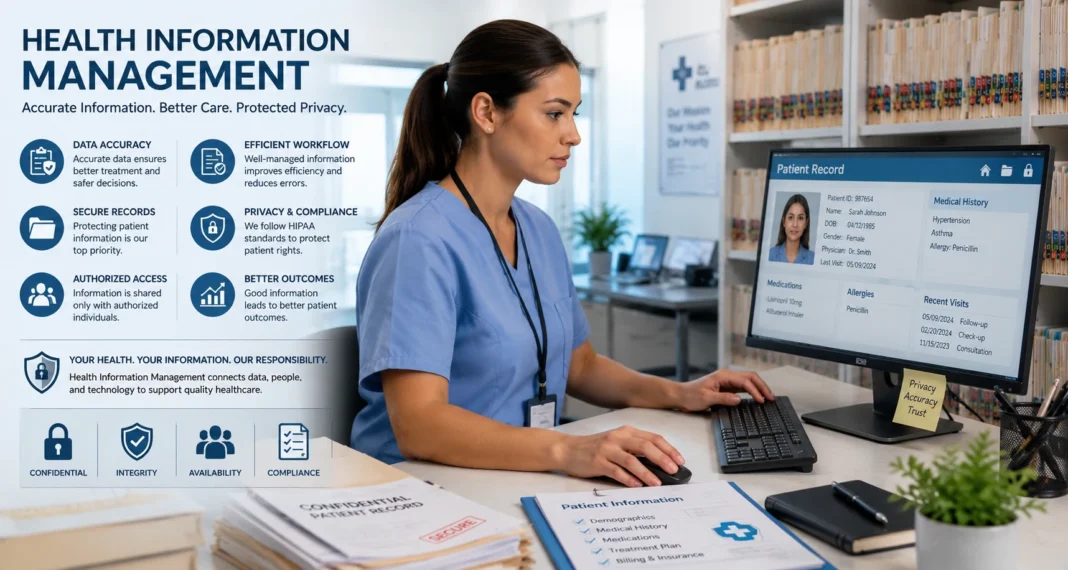
A patient record can look simple, but every detail inside it has a job. Doctors use it to make care decisions. Hospitals use it to keep treatment organised. Health plans use it to review claims. Health information management keeps those details clear, protected, and tied to the right patient. When even one part is wrong, the problem can reach far beyond the record itself.
Patients rarely see the people who manage these records. They may never meet the person who fixes a duplicate file, checks who accessed a record, or corrects a medical code. Even so, that work can have a direct effect on their care. A missing allergy can lead to the wrong medicine. An old drug list can confuse an emergency team. A test result placed in another patient’s file can delay treatment. Even a short or unclear clinical note can cause problems when a health plan reviews a claim.
That is why health information management matters. It helps the healthcare system use patient information safely, accurately, and at the right time.
The Patient Record Is More Than a File
A medical visit creates more than a doctor’s note. Nurses add vital signs, pharmacists check medicines, and coders review services for claims. Patients may later need the same record for a specialist, second opinion, or billing issue.
Each visit can add test results, scans, referrals, insurance details, and medical codes. These parts must stay clear, correct, and useful. Problems start when details conflict. A medicine list may not match the doctor’s note, or a referral may miss key information. HIM helps prevent this confusion. It sets rules for record access, updates, corrections, and proper use.
More Data Does Not Always Mean Better Care
Electronic records can contain hundreds of pages. A large file may look complete, but it can still hide the fact that matters. Repeated notes often create noise. Old details may sit beside current information. A useful scan report may appear inside a file that is hard to search. Staff may create two profiles for the same patient.
A short and accurate record can offer more value than a long record full of repeated text. Good health information management does not focus only on how much data exists. It also checks whether the information is current, clear, correct, and useful.
This matters during an urgent visit. A doctor may have only a few minutes to check medicines, allergies, recent tests, and past conditions. Important facts should not disappear inside copied notes or unrelated details.
One Visit Can Create Records Across Several Systems
An urgent care visit can go wrong before the doctor even starts the exam. A patient with severe stomach pain may look like a simple case, but the clinic first needs to match that person with the correct file. That check matters more than it seems. A wrong date of birth or phone number can create a second profile or send new details into another patient’s history. Once the identity is clear, the clinical team adds the details of the visit. Symptoms, vital signs, medicines, allergies, test requests, and the doctor’s first assessment all become part of the same case.
A laboratory may add blood test results. A pharmacy may receive an electronic prescription. A specialist may receive a referral if the patient needs further care. A medical coder reviews the services documented in the record. The coder then assigns standard codes that help the clinic prepare an insurance claim.
The visit may end, but the information remains active. Staff may need it for follow-up care, a payment review, an audit, or a future appointment. The patient may also request a copy. HIM connects these separate steps. It helps keep each result, note, code, and claim linked to the correct patient.
Small Mistakes Can Travel Far
A record error may start in one department and affect several others. A wrong address can send a private letter to another household. A duplicate patient profile can create two bills for one visit. An old insurance plan can delay a claim. A missing referral note can cause a specialist to order another test. Clinical errors may create a greater risk. A serious drug allergy may exist in an old note but not in the active allergy list.
A recent scan may sit inside another hospital’s system. A medicine that the patient stopped months ago may still appear as current. No healthcare organization can prevent every human error. Strong HIM practices make those mistakes easier to spot and correct. Identity checks, record audits, clear documentation rules, staff education, and formal correction processes all help reduce the risk. The goal is not to create a perfect system. The goal is to stop one bad entry from becoming several bad decisions.
Privacy Affects Patient Trust
Medical records can contain very private details, such as mental health notes, reproductive care, genetic results, or a serious diagnosis. Patients share this information because it may affect their care, not because every employee needs to see it.
HIPAA allows access for valid reasons such as treatment, payment, and healthcare operations. Access should match the person’s role. A billing worker may need insurance details, while a doctor may need the medical history. Electronic systems can also record who opened a file and when. This helps organizations review unusual access. Privacy does not mean hiding the record from everyone. It means giving access only to the people who need it.
A Fitness App Is Not the Same as a Hospital Record
Many consumers assume that HIPAA protects every piece of health data. That belief can lead to poor privacy choices. A hospital record and a fitness app may both contain sensitive information. The same rules may not apply to both. HIPAA usually applies when a covered healthcare organization or an approved business partner holds the information. A fitness tracker, diet service, wellness website, period app, or connected device may fall outside that system.
Other federal rules, state laws, contracts, and company policies may still apply. The level of protection can differ from one service to another. This matters because a person may enter private details into an app and assume that the information receives the same protection as a doctor’s record.
Users should review how a service collects, stores, uses, and shares health information. The privacy policy may also explain whether the company uses personal data for ads or provides it to other businesses. The wording may be difficult to read, but the details matter. Health data held by a consumer app may receive different treatment from information inside a covered healthcare system.
Patients Can Review Their Own Records
A medical record is not only for doctors, hospitals, or health plans. Patients may also ask to see the information kept about them. This can be useful before a specialist visit, after a change of doctor, or when a bill does not look right. Test results, clinical notes, claims, and billing details may all help the patient understand what happened.
Record access can also bring mistakes to light. An old medicine, wrong allergy, or incorrect surgery date may stay in the file until someone notices it. Patients can ask the provider or health plan to review the issue and explain why the information should be corrected.
Electronic Records Still Depend on People
Electronic health records can place prescriptions, test results, clinical notes, referrals, alerts, and billing details inside one system. That does not make every entry accurate. A clinician may copy an old note into a new visit. Staff may place a result under the wrong section. A medicine list may remain out of date. Two profiles may exist for one patient. An imported document may arrive without enough context.
Long records can create another problem. Important facts may sit inside pages of repeated text. Technology stores the information people enter. It cannot always decide whether that information makes sense. HIM professionals work with doctors, nurses, coders, privacy officers, compliance staff, and technical teams. They may review duplicate records, access rules, data standards, retention policies, and documentation quality.
An advanced electronic system with weak data can still support a poor decision. A simpler system with strong record control may serve patients better.
Health Information Has to Follow the Patient
One provider rarely holds the patient’s full medical history. A person may visit a family doctor, laboratory, pharmacy, imaging centre, specialist, urgent care clinic, and hospital. Each organization may use different software.
Health information exchange helps authorized organizations share patient data in electronic form. It can improve care coordination, reduce repeated tests, and help providers avoid preventable mistakes. Interoperability goes beyond a basic transfer. It means that different systems can exchange information and use it in a practical form.
A hospital may send a scanned PDF to a physician. The data has moved, but the doctor may still need to search several pages for one result. A stronger exchange can place allergies, medicines, diagnoses, and test results inside the correct fields of the receiving system. Technology alone cannot solve every exchange problem. Patient identity errors, different formats, local policies, technical limits, and staff workflows can interrupt the process. Small practices, behavioural health services, and long-term care facilities may also face greater barriers than large hospital systems.
HIM Is Not Another Name for Health IT
Several healthcare data fields overlap. That often causes confusion.
| Field | Main role | Simple example |
|---|---|---|
| Health information management | Protects record quality, privacy, access, and proper use | Review of record accuracy and access rules |
| Health informatics | Uses data and technology to improve healthcare decisions | Creation of a clinical decision tool |
| Health information technology | Supports the systems that store and transfer health data | Maintenance of electronic record software |
| Medical coding | Applies standard codes to documented diagnoses and services | Assignment of an ICD-10-CM code |
| Health information exchange | Transfers health data between approved organizations | Transfer of hospital records to a doctor |
| Healthcare data analytics | Reviews data to find patterns and guide decisions | Study of hospital readmission rates |
These areas often work together. A medical coder may work inside an HIM department. An HIM manager may help an IT team plan a software update. An informatics specialist may rely on data quality rules created through HIM. A simple distinction can help. Health IT asks whether the system works. Health informatics asks how data and technology can improve a decision. HIM asks whether the information is accurate, private, lawful, clear, and ready for proper use.
Medical Coding Covers Only One Part of HIM
Medical coding plays an important role in healthcare payment and reporting. It does not represent the whole HIM field. A coder reviews clinical documentation and assigns standard codes to diagnoses, procedures, services, and equipment. These codes help providers and health plans understand the care that took place.
Coding also supports claims, payment, research, quality reviews, and healthcare reports. HIM has a wider scope. It also covers patient identity record access privacy, release of information, data quality, retention, audits, compliance, and information governance. A person can work in HIM without coding medical records each day.
Career paths may include privacy, clinical documentation, compliance, cancer registry work, data quality, analytics, and department leadership. This difference matters for students who assume that every HIM role has the same duties.
Medical Bills Depend on the Record
A healthcare claim cannot stand apart from the clinical record. An insurer may delay a claim when the notes do not explain why a service took place. An incorrect code may cause a denial. A duplicate patient profile may create two charges for one visit. HIM staff help connect the medical record with administrative data.
Their role is not to change a diagnosis to gain payment. Their role is to help ensure that the documentation reflects the care provided and supports the code used on the claim. Clear records can help a provider answer an audit, review a denied claim, explain a charge, and find a billing error. This protects the provider, the health plan, and the patient. Healthcare organizations need payment for valid services. Patients need bills that match the care in their records.
Hospital Reports Can Be Wrong Even When They Look Professional
A patient record supports one person’s care. Combined records can also help a hospital study wider patterns. A hospital may review return visits after discharge, test delays, appointment problems, infections, treatment outcomes, claim delays, staff needs, and gaps in follow-up care. These reports may look precise, but the source data can still contain problems. Duplicate records can raise patient counts, missing values can hide patterns, and different definitions can distort results.
A rise in a diagnosis may show a real health trend, or it may reflect a new code. HIM professionals help analysts understand where the data came from and what limits affect it. A polished chart should not guide an important decision until someone understands what the numbers represent.
Public Health Also Relies on Accurate Records
Health information can support work outside a hospital or clinic. Public health agencies may use authorized data to detect outbreaks, study disease patterns, track vaccination levels, and plan services. Weak information reduces the value of that work.
A late laboratory report can slow an outbreak response. An incorrect address can hide where cases appear. Different definitions can make data from two healthcare organizations hard to compare. Public health data needs clear standards, secure systems, and careful review. The purpose is not to expose private patient details. The purpose is to provide useful information under the correct legal and privacy controls.
AI Can Save Time and Still Create a New Error
Artificial intelligence now appears in medical coding, document review, record summaries, data analysis, and administrative work. An AI tool may classify documents, find duplicate records, suggest codes, summarize notes, or flag missing information. These tools can save time. They can also make convincing mistakes.
An automated summary may leave out an allergy. A coding tool may suggest a code that the record does not support. A model may repeat bias found in old data. An outside system may create privacy concerns if it receives protected information. AI may reduce some routine tasks, but it does not remove the need for HIM professionals. It changes the work they perform.
Healthcare organizations still need people who can review results, investigate errors, create data standards, protect privacy, and decide when a tool should not control a decision. AI can process information. It cannot accept legal or professional responsibility for a patient record.
Software Skills Are Useful but Judgment Matters More
Healthcare software can change when a worker moves to another hospital, health plan, or medical practice. Core HIM skills remain useful across different systems. These include attention to detail, clear communication, respect for privacy, knowledge of medical terms, confidence with data, and an understanding of healthcare workflows.
Software can show that a field contains information. It cannot always tell the user that the information makes no sense. A system may accept two records for one patient. It may accept a future date for a procedure that already happened. It may display two conflicting medicine lists without a clear warning.
A trained professional knows when to stop, check the source, and correct the record. That judgment separates health information management from basic data entry.
Patients Can Help Keep Their Records Accurate
Patients do not need professional HIM training to help protect record quality.
A few simple habits can reduce errors:
- Use the same legal name and correct date of birth at each healthcare organization.
- Keep a current list of medicines, allergies, diagnoses, and past procedures.
- Review test results, visit summaries, and patient portal details.
- Ask the provider to review information that appears wrong or incomplete.
- Request key records before a specialist visit or a change of doctor.
- Protect portal passwords and avoid insecure messages for sensitive information.
- Check an app’s privacy rules before sharing health details.
Patients should not try to interpret complex medical information without professional help. They can still check whether the basic record matches their history and recent care. A patient may notice an old medicine, incorrect contact detail, or missing allergy before that error affects another appointment.
The Record Still Matters After the Visit Ends
A medical record has a life beyond one appointment. Healthcare organizations need rules for how information enters a system, who may change it, how staff check quality, and who can access each part. They also need policies for record requests, backups, legal holds, system changes, retention periods, mergers, and secure destruction.
This wider structure is often called information governance. Good governance gives clear responsibility to people and teams. It also reduces conflict between departments. A hospital may have advanced software and still face problems if two departments use different definitions for the same data. Shared rules help the organization handle information in a consistent way.
More Data Does Not Always Mean Better Care
Electronic records can contain hundreds of pages. A large file may look complete, but it can still hide the fact that matters. Repeated notes often create noise. Old details may sit beside current information. A useful scan report may appear inside a file that is hard to search. Staff may create two profiles for the same patient.
A short and accurate record can offer more value than a long record full of repeated text. Good health information management does not focus only on how much data exists. It also checks whether the information is current, clear, correct, and useful.
This matters during an urgent visit. A doctor may have only a few minutes to check medicines, allergies, recent tests, and past conditions. Important facts should not disappear inside copied notes or unrelated details.
One Visit Can Create Records Across Several Systems
A laboratory may add blood test results, a pharmacy may receive an electronic prescription, and a specialist may receive a referral if further care is needed. A medical coder reviews the documented services and assigns standard codes for the insurance claim.
The visit may end, but the information remains active. Staff may need it for follow-up care, a payment review, an audit, or a future appointment. The patient may also request a copy. HIM connects these steps and keeps each result, note, code, and claim linked to the correct patient.
Small Mistakes Can Travel Far
A record error may start in one department and affect several others. A wrong address can expose private information. A duplicate profile can create two bills, and an old insurance plan can delay a claim.
Clinical errors may be more serious. An allergy may be missing, a recent scan may stay in another system, or an old medicine may still appear as current. Strong HIM practices help staff find and correct these problems before one bad entry leads to several bad decisions.
Health Apps Do Not Always Follow Hospital Privacy Rules
Health data inside a hospital system usually receives stronger legal protection than information entered into a consumer app. Fitness trackers, period apps, diet services, and wellness platforms may collect sensitive details, but HIPAA may not cover them. Their privacy rules can depend on other laws and the company’s own policies.
Before using an app, users should check where their data goes, who can access it, and whether it may be used for advertising or shared with other companies.
Electronic Records Still Depend on People
Electronic health records can place prescriptions, test results, clinical notes, referrals, alerts, and billing details inside one system. That does not make every entry accurate. A clinician may copy an old note into a new visit. Staff may place a result under the wrong section. A medicine list may remain out of date. Two profiles may exist for one patient. An imported document may arrive without enough context.

Long records can create another problem. Important facts may sit inside pages of repeated text. Technology stores the information people enter. It cannot always decide whether that information makes sense. HIM professionals work with doctors, nurses, coders, privacy officers, compliance staff, and technical teams. They may review duplicate records, access rules, data standards, retention policies, and documentation quality.
An advanced electronic system with weak data can still support a poor decision. A simpler system with strong record control may serve patients better.
Health Information Has to Follow the Patient
One provider rarely holds the patient’s full medical history. A person may visit a family doctor, laboratory, pharmacy, imaging centre, specialist, urgent care clinic, and hospital. Each organization may use different software. Health information exchange helps authorized organizations share patient data in electronic form. It can improve care coordination, reduce repeated tests, and help providers avoid preventable mistakes.
Interoperability goes beyond a basic transfer. It means that different systems can exchange information and use it in a practical form. A hospital may send a scanned PDF to a physician. The data has moved, but the doctor may still need to search several pages for one result. A stronger exchange can place allergies, medicines, diagnoses, and test results inside the correct fields of the receiving system.
Technology alone cannot solve every exchange problem. Patient identity errors, different formats, local policies, technical limits, and staff workflows can interrupt the process. Small practices, behavioural health services, and long-term care facilities may also face greater barriers than large hospital systems.
HIM Is Not Another Name for Health IT
Several healthcare data fields overlap. That often causes confusion.
| Field | Main role | Simple example |
|---|---|---|
| Health information management | Protects record quality, privacy, access, and proper use | Review of record accuracy and access rules |
| Health informatics | Uses data and technology to improve healthcare decisions | Creation of a clinical decision tool |
| Health information technology | Supports the systems that store and transfer health data | Maintenance of electronic record software |
| Medical coding | Applies standard codes to documented diagnoses and services | Assignment of an ICD-10-CM code |
| Health information exchange | Transfers health data between approved organizations | Transfer of hospital records to a doctor |
| Healthcare data analytics | Reviews data to find patterns and guide decisions | Study of hospital readmission rates |
These areas often work together. A medical coder may work inside an HIM department. An HIM manager may help an IT team plan a software update. An informatics specialist may rely on data quality rules created through HIM.
A simple distinction can help. Health IT asks whether the system works. Health informatics asks how data and technology can improve a decision. HIM asks whether the information is accurate, private, lawful, clear, and ready for proper use.
Medical Bills Depend on the Record
A healthcare claim cannot stand apart from the clinical record. An insurer may delay a claim when the notes do not explain why a service took place. An incorrect code may cause a denial. A duplicate patient profile may create two charges for one visit. HIM staff help connect the medical record with administrative data.
Their role is not to change a diagnosis to gain payment. Their role is to help ensure that the documentation reflects the care provided and supports the code used on the claim. Clear records can help a provider answer an audit, review a denied claim, explain a charge, and find a billing error. This protects the provider, the health plan, and the patient. Healthcare organizations need payment for valid services. Patients need bills that match the care in their records.
Hospital Reports Can Be Wrong Even When They Look Professional
A patient record supports one person’s care. Combined records can help a hospital study return visits, test delays, infection rates, treatment results, claim problems, and gaps in follow-up care. These reports may look precise, but the source data can still be weak. Duplicate records can raise patient counts, missing values can hide patterns, and different definitions can distort results.
A rise in a diagnosis may show a real trend, or it may appear because staff started using a new code. HIM professionals help analysts understand where the data came from and what limits affect it. A polished chart should not guide an important decision until the numbers are fully understood.
Public Health Also Relies on Accurate Records
Health information can support work outside a hospital or clinic. Public health agencies may use authorized data to detect outbreaks, study disease patterns, track vaccination levels, and plan services. Weak information reduces the value of that work.
A late laboratory report can slow an outbreak response. An incorrect address can hide where cases appear. Different definitions can make data from two healthcare organizations hard to compare. Public health data needs clear standards, secure systems, and careful review. The purpose is not to expose private patient details. The purpose is to provide useful information under the correct legal and privacy controls.
AI Can Save Time and Still Create a New Error
AI is changing how health information teams work, but it is not replacing them. It can help with coding, record summaries, duplicate files, and missing information. However, it can also miss an allergy, suggest the wrong code, repeat bias, or create privacy risks.
That is why human review still matters. HIM professionals check results, investigate errors, protect patient data, and decide when an AI tool should not be trusted. AI can process information, but it cannot take responsibility for a patient record. Protecting medical data requires secure systems, controlled access, staff awareness, and clear response procedures.
There Is No Single Route Into an HIM Career
HIM careers are not all the same. One person may work in medical coding, while another handles privacy, registration, data quality, or health technology. The education path depends on the role. Some jobs accept a certificate or associate degree. Others may require a bachelor’s degree, experience, or a professional credential.
Students should first check the exact job requirements, then choose a suitable program. As automation grows, skills in privacy, compliance, data quality, analysis, and professional judgment will matter even more.
Software Skills Are Useful but Judgment Matters More
Healthcare software can change when a worker moves to another hospital, health plan, or medical practice. Core HIM skills remain useful across different systems. These include attention to detail, clear communication, respect for privacy, knowledge of medical terms, confidence with data, and an understanding of healthcare workflows.
Software can show that a field contains information. It cannot always tell the user that the information makes no sense. A system may accept two records for one patient. It may accept a future date for a procedure that already happened. It may display two conflicting medicine lists without a clear warning.
A trained professional knows when to stop, check the source, and correct the record. That judgment separates health information management from basic data entry.
Patients Can Help Keep Their Records Accurate
Patients do not need professional HIM training to help protect record quality.
A few simple habits can reduce errors:
- Use the same legal name and correct date of birth at each healthcare organization.
- Keep a current list of medicines, allergies, diagnoses, and past procedures.
- Review test results, visit summaries, and patient portal details.
- Ask the provider to review information that appears wrong or incomplete.
- Request key records before a specialist visit or a change of doctor.
- Protect portal passwords and avoid insecure messages for sensitive information.
- Check an app’s privacy rules before sharing health details.
Patients should not try to interpret complex medical information without professional help. They can still check whether the basic record matches their history and recent care. A patient may notice an old medicine, incorrect contact detail, or missing allergy before that error affects another appointment.
The Record Still Matters After the Visit Ends
A medical record has a life beyond one appointment. Healthcare organizations need rules for how information enters a system, who may change it, how staff check quality, and who can access each part. They also need policies for record requests, backups, legal holds, system changes, retention periods, mergers, and secure destruction.
This wider structure is often called information governance. Good governance gives clear responsibility to people and teams. It also reduces conflict between departments. A hospital may have advanced software and still face problems if two departments use different definitions for the same data. Shared rules help the organization handle information in a consistent way.
Every Record Belongs to a Real Person
Healthcare organizations deal with software, codes, forms, claims, audits, and deadlines every day. It is easy to focus on the system and forget what the record represents. Each record belongs to a patient. A wrong entry can affect a prescription. A missing report can delay an answer. A privacy failure can expose a painful part of someone’s life.
Health information management protects that record as it moves through the healthcare system. A useful medical record must be accurate enough to support care, secure enough to protect the patient, and available to the right person when needed.
FAQs
HIM keeps patient information correct, private, and ready for use. It also helps healthcare teams manage records without mixing or losing important details.
Health IT manages the software. HIM manages the information stored inside that software.
Access depends on the person’s role and reason. Staff should only see the information needed for their work.
The system stores what people enter. Copied notes, old medicines, duplicate profiles, and misplaced results can still create problems.