


Joint pain can make changes in someone’s life that may be underrated. Rising each morning with severe pain in one’s knee joint or shoulder joint can be extremely disruptive to one’s life. The simple joys of walking up the stairs, carrying a child around in arms, or taking an early morning walk become difficult and even exhausting tasks. Joint stiffness and swelling in many individuals cause extreme frustration and make even the most minute movement seem extremely difficult.
In some cases, when drugs, rest, and physical therapy are unable to offer adequate relief, then there comes the need for surgery. But in the minds of many people, the thought of this can evoke fear. It will mean having large incisions, a hospital stay for a considerable period of time, and then weeks or even months of recovery. Fortunately for them, there is an alternative to that in today’s joint care methods.
Arthroscopic surgery is a type of surgery that uses very small openings and a very small camera to give the surgeon a chance to view and operate on the problems within a joint. This article briefly explains arthroscopic surgery for quicker healing and less pain, so that patients do not become fearful while opting for this procedure.
What Is Arthroscopic Surgery?
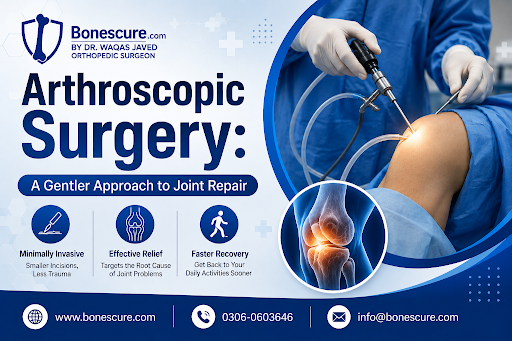
Arthroscopic surgery is a form of minimally invasive surgery that helps in inspecting and treating abnormalities within a joint. Small cuts are made around the joint being operated on. An arthroscope, which is a thin device, is inserted into one of these cuts.
An arthroscope has a tiny camera and a light attached to the end. The camera transmits detailed images onto a monitor in the operating theater. Additional devices can also be inserted through adjacent cuts depending on the specific abnormality being treated. This includes removal of worn-out tissues, repair of injuries, smoothing of rough parts, among others. Arthroscopic surgery is performed on joints such as:
- Knee
- Shoulder
- Hip
- Ankle
- Wrist
- Elbow
Why Smaller Incisions Mean Quicker Healing
The human body is incredibly adaptable; however, conventional surgery involves immense damage to healthy muscle tissue, blood vessels, and nerve endings in order to access the affected region. By avoiding these problems altogether, keyhole surgeries provide numerous physical and psychological advantages. The following are the reasons why arthroscopic surgery for quicker healing is preferred:
1. Minimal Tissue Trauma and Less Post-Surgical Pain
For traditional surgery, the most painful experience often comes from muscle and tissue incisions. Due to the minimal size of arthroscopic surgery cuts, muscle tissue is merely separated and not severed, which leads to:
- Much less pain during the recovery period
- Need for less powerful painkillers
- Minimal muscle inflammation
Moreover, small incisions are easier to take care of and may result in fewer scars.
2. Lower Risk of Infection
Large surgical openings involve a lot of care and have a much higher chance of infection due to airborne or bacterial invasion. Small portals are made in arthroscopic surgery for quicker healing, and they form small scabs within several days. Due to this, the infection risk is almost minimal.
3. Quick Restoration of Normal Range of Motion
As long as there is no damage to the tissue, the level of internal swelling will be minimized as much as possible. Low levels of swelling help keep the joint capsule moist and flexible so that patients can start doing mobilization exercises right after the operation.
4. Same-Day Outpatient Convenience
Almost all keyhole procedures are outpatient operations. Patients come to the hospital in the morning, get their repair done, and spend some time in the recovery room before going home and resting in their beds.
Arthroscopy vs. Traditional Open Surgery: A Quick Comparison
The following table highlights the essential differences between traditional open joint repair and modern keyhole techniques:
| Feature / Metric | Traditional Open Joint Surgery | Modern Arthroscopic Keyhole Surgery |
| Incision Size | 4 to 8 inches (requires deep cutting) | 2 to 3 tiny portals (approx. 4–6 mm each) |
| Muscle & Tissue Distruption | Significant cutting and retracting | Minimal; instruments slide between fibers |
| Hospital Stay | 2 to 4 days of inpatient observation | Outpatient procedure (home the same day) |
| Post-Operative Discomfort | Moderate to severe surgical pain | Mild to moderate, easily managed |
| Cosmetic Appearance | Large, noticeable linear scar | Tiny, barely visible puncture marks |
| Initial Recovery Window | 8 to 16 weeks for routine tasks | 2 to 6 weeks for standard daily activities |
| Infection & Complication Risk | Moderate | Very low |
Of course, this comparison doesn’t necessarily imply that an arthroscopic surgery for quicker healing is the best procedure to perform all the time. Sometimes, there might be no choice except for performing open surgery. Other times, it may be a case where non-surgical treatment would be a preferred solution. Again, everything depends on the particular patient’s situation.
The Recovery Process: What Patients Might Experience
It may happen that after an arthroscopy, an individual can experience some pain, swelling, stiffness, or even bruising. However, the usual recovery process is similar for most of the patients. Since individuals are of different ages and their joints are operated on differently, there may be some differences from one individual to another during recovery time. The medical team may recommend:
- Rest during the early stage
- Ice to help control swelling
- Prescribed or recommended pain relief
- Gentle movement
- Physical therapy
- Weight-bearing restrictions when needed
- Gradual return to normal activities
The Emotional Side of a Faster Recovery
Joint problems can make patients feel limited, as simple tasks may become difficult and activities such as exercise or social interaction may be avoided. While arthroscopic surgery can help address certain joint conditions, Knee Replacement Surgery may be considered for patients with severe, advanced joint damage when other treatment options are no longer effective.
The joy of being able to rise from bed, walk with more assurance, return to work, or participate in a beloved hobby is a very rewarding one emotionally. After months of being careful with the troublesome joint, the progress may feel like a massive leap forward. Of course, not all patients will recover quickly. However, when arthroscopy is necessary, it can facilitate their path back to normal life due to its minimally invasive nature.
Stepping Forward into a Pain-Free Future
With the advent of arthroscopic surgery for quicker healing, many joint conditions can now be managed without resorting to making large cuts into the body for the purpose of gaining entry.
With the use of a tiny camera and other specially designed tools, the surgeon can perform surgery through a few small incisions into the joint itself. When it applies to suitable candidates, arthroscopic surgery could lead to less physical injury and a potentially easier postoperative experience.
This is the true appeal of arthroscopic surgery in allowing faster recovery. This is the concept that a less intrusive operation could alleviate some of the physical challenges involved in recovery.