


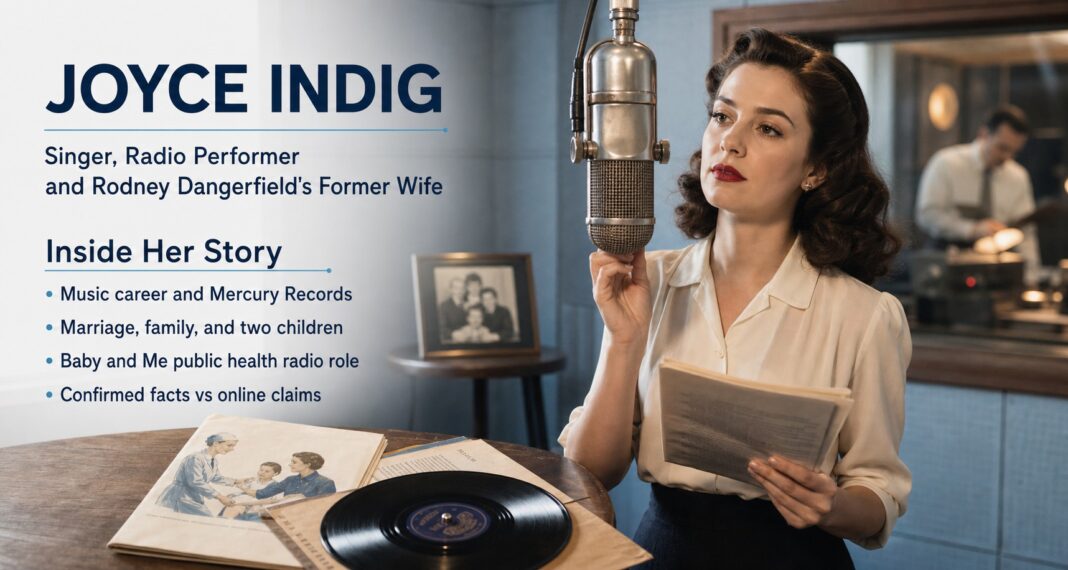
A 14-minute radio drama from 1949 preserves one of the clearest records of Joyce Indig’s career. In Baby and Me, she played a pregnant woman who learns that she has syphilis. The program used her character’s story to teach listeners about blood tests, penicillin, and prenatal care. That role may seem far removed from the name most often linked to Joyce today. She later married comedian Rodney Dangerfield and became the mother of his two children. His fame eventually pushed her own work into the background. Joyce had a career before Dangerfield became a star. She sang, made records, and took part in an early American public health campaign. The basic facts survive, but much of her private life remains poorly documented. Exact dates, health claims, and even her reported birth name require caution.
A Singer Before She Became a Famous Comedian’s Wife
Established accounts of Rodney Dangerfield’s life identify Joyce Indig as a singer. Music listings and radio archives offer direct support for that description. A singer in the late 1940s did not need a major album or national tour to have a professional career. Artists often moved between clubs, radio studios, orchestras, promotional records, and live events. Television had not yet taken radio’s central place in American homes.
Many performers worked steadily without becoming stars. Their names appeared on records or production notes, but newspapers rarely documented their lives in depth. Much of that material later disappeared. Joyce seems to fit this pattern. Her available catalog is small, yet it proves that she had an identity in entertainment before Rodney Dangerfield reached national fame. Calling her only his former wife gives readers an incomplete picture.
The Mercury Record That Still Survives
Discography records connect Joyce Indig to a Mercury Records release from 1950. It was a 10-inch, 78 RPM promotional disc with catalog number 5509.
The two sides contained:
- The Black Rose
- Ev’rybody Clap Hands
Records of this type often went to radio stations, reviewers, and people inside the music business. They were not always released to the public in the same way as regular commercial singles. Another surviving recording credits Joyce with a performance of Irving Berlin’s The Best Thing for You. Harry Geller conducted the orchestra, and a vocal chorus supported the performance.
This evidence establishes a real music career, but it does not reveal its full size. No solid record shows that Joyce released a major album, achieved chart success, or became a leading star. The fair description is simple: she was a professional singer with documented recordings. That may sound modest, but it is more accurate than either extreme. Her work should not disappear beneath her husband’s name, and it should not be enlarged beyond what the surviving evidence supports.
Baby and Me Put Her Voice Inside a Health Campaign
Joyce’s most unusual credit came through Baby and Me. The WNYC archive identifies her as Laura, the lead female character.
The program belongs to the Venereal Disease Radio Project, an education campaign developed through work connected to the United States Public Health Service and Columbia University. The series addressed syphilis and gonorrhea through songs, fictional stories, brief announcements, films, pamphlets, and other public material. Archive records place Baby and Me in 1949. Some online listings display a precise date that acts only as a placeholder because the original broadcast day is unknown. The year is useful; the exact day is not firmly established.
The campaign addressed a problem that medicine alone could not solve. Penicillin offered an effective treatment, but people still needed to recognize the risk and seek care. Fear, shame, and poor information often kept patients away from doctors. A radio drama could reach people who would never read a medical booklet. It also gave health officials room to discuss a sensitive subject through fictional characters rather than a formal lecture.
Laura and Bill Carry the Medical Lesson
Baby and Me tells its story in about 14 minutes. Joyce plays Laura, who meets a Merchant Marine named Bill. The pair marry, and Laura becomes pregnant. Bill later leaves for work at sea. News reaches Laura that the ship he was meant to board has sunk. She assumes that he died with the crew.
He was never aboard.
A blood test had shown that Bill had syphilis. Officials stopped him from joining the voyage, and he received treatment. He eventually returns home and tells Laura what happened. He also urges her to see a doctor because she may have the infection. Laura learns that she has syphilis. She receives penicillin early enough in her pregnancy to prevent harm to the unborn child. The drama ends after she gives birth to a healthy son and Bill returns to his family.
The plot carries several practical messages without pausing for a long medical explanation. An infection may exist even when a person feels well. Both partners may need tests. A missing symptom does not prove that the disease has gone. Shame can delay care, and treatment during pregnancy can protect a baby. The production belongs to another era. Some of its language, attitudes, and dramatic choices may sound dated today. The central advice was direct and useful: get tested, tell your partner, and seek qualified medical care.
Radio Reached People Medicine Could Not
Syphilis and gonorrhea were major public health concerns in the United States during the 1940s. Penicillin changed what doctors could do, but treatment could only help people who received a diagnosis.
Stigma created a serious barrier. Some patients feared judgment from their families or communities. Others turned to questionable remedies. A person might also assume that the infection had resolved once a rash or sore disappeared. Radio gave public health authorities access to millions of homes. Listeners did not have to enter a clinic, attend an event, or ask for a pamphlet before hearing the message.
The wider VD Radio Project drew on a striking list of performers. Preserved programs include work associated with Woody Guthrie, Hank Williams, Red Foley, and Sister Rosetta Tharpe. Public figures also recorded short notices that encouraged medical tests and treatment. Joyce’s role was part of this larger effort. She did not direct the campaign, write its health policy, or provide clinical advice. She used her voice as an actor and singer to make the message understandable. That distinction keeps her contribution in proper proportion. “Public health performer” fits the evidence. “Medical expert,” “campaign founder,” or “health professional” does not.
The 1949 Story and Medical Advice Today
No one should use an old radio drama as a guide to personal treatment. Tests, prenatal care, and clinical standards have changed since Baby and Me first aired. The main health issue in the story remains serious. Syphilis can pass from a pregnant patient to the fetus. Untreated infection may lead to miscarriage, stillbirth, premature birth, infant death, congenital syphilis, or lasting health problems in the child.
Current guidance from the U.S. Centers for Disease Control and Prevention calls for syphilis screening at the first prenatal visit. A patient may need further tests later in pregnancy due to personal risk, local infection levels, or medical guidance. Penicillin G remains the only treatment with documented effectiveness against syphilis during pregnancy and fetal infection. The correct medicine and schedule depend on the stage of the disease and the patient’s clinical needs. A licensed healthcare professional must make that decision.
The ending of Baby and Me was designed to offer hope. Laura gets a test, receives treatment, and has a healthy baby. The details come from a fictional script, but the practical lesson remains sound. Early prenatal care gives medical professionals more time to detect the infection and prevent serious harm.
Then Came Rodney Dangerfield
Joyce married Jacob Rodney Cohen, who later became famous as Rodney Dangerfield. During the earlier part of his career, he also used the professional name Jack Roy. Sources disagree about the first marriage date. Several established accounts place it in 1951. Others give 1949. The records also differ on whether their first divorce occurred in 1961 or 1962.
The broad order of events is more secure than every exact date:
- Joyce and Rodney married in the early 1950s.
- Their first marriage ended around 1961 or 1962.
- They remarried in 1963.
- Their second and final divorce occurred in 1970.
A separation date, filing date, and final court date do not always match. This may explain some of the conflict, though the available material does not settle it. Rodney was not yet the famous comedian audiences later saw in Caddyshack and Back to School. His early work in comedy brought little security. He left show business for a time and sold paint and aluminum siding to support his household.
The family lived in Englewood, New Jersey. Rodney eventually returned to clubs and built the anxious, unlucky stage character known for the line “I don’t get no respect.” His return worked, but success did not arrive at once. Years of club appearances and television spots passed before he became one of America’s best-known comedians.
Brian and Melanie Lived Through Both Marriages
Joyce and Rodney had two children, Brian Roy and Melanie Roy. Some sources use the name Melanie Roy-Friedman for their daughter. Brian was reportedly born in 1960. Melanie arrived after her parents reconciled and married again. Few reliable sources describe their childhood in detail or explain Joyce’s daily role at home.
Most accounts of the family period center on Rodney. They discuss his money problems, sales work, return to comedy, and time away at clubs. This creates an uneven record. His view survives through interviews and biographies, but Joyce’s account is difficult to find. The marriage included separation, divorce, reconciliation, and another divorce. Those facts show that the relationship was complicated. They do not reveal which person caused each problem.
A fair account should resist the urge to fill that silence with assumptions. Joyce’s lack of public statements does not prove that she lacked a perspective. It shows that the press preserved one side far better than the other.
Fame Reduced Joyce to a Line in Someone Else’s Biography
Rodney Dangerfield’s career eventually grew far beyond the clubs where he had struggled. He became a television regular, a successful recording artist, a nightclub owner, and a film actor.
His best-known films include:
- Caddyshack
- Easy Money
- Back to School
- Ladybugs
- Natural Born Killers
His comedy album No Respect also won a Grammy Award. That level of fame changed the way later writers described Joyce. Her name often appeared only in a sentence about Rodney’s first marriage. Her work as a singer and radio performer received far less attention.
This is not an unusual problem in entertainment history. A woman’s own career can shrink into a biographical note once a husband or former husband becomes more famous. Repeated summaries then replace the fuller record. The surviving evidence pushes back against that narrow version. Joyce made records before Rodney became a star. She also held the main female role in a preserved public health drama. Her career may have been short, but it did not begin as an extension of his success.
Her Final Years Are Not Well Documented
Memorial records report that Joyce died in 1977 at about 49 or 50 years old. Accessible sources do not provide a reliable account of her death. Several modern pages say that severe arthritis affected her later life. That statement appears to trace back to memorial material and secondhand reports. A strong contemporary report or accessible medical source has not confirmed it. The same standard applies to reports about James Carville’s wife’s health, where confirmed public facts must remain separate from online rumors. Repetition across websites does not turn a weak claim into a verified diagnosis. It is reasonable to say that arthritis has been reported, but it should not appear as an unquestioned fact. The same caution applies to her cause of death. No cause should be assigned without a dependable obituary, death record, or other authoritative source.
Where the Online Story Starts to Break Down
Joyce Indig’s limited paper trail has left space for biography sites to supply confident answers. Several of those answers need qualification.
Was Joyce E. Roy Her Birth Name?
Some pages identify her as Joyce E. Roy. The claim is questionable because Roy was closely tied to Rodney Dangerfield, who legally used the name Jack Roy. Historical accounts generally call her Joyce Indig. No clear primary source establishes Joyce E. Roy as her original name. It may reflect a married name, a record mix-up, or later confusion.
Was She Born in 1927?
The year appears in memorial and genealogy records, so it may be correct. Some pages also publish an exact date. A widely accessible birth certificate or strong contemporary source has not confirmed that date. The accurate wording is “reportedly born in 1927,” unless stronger documentation becomes available.
Did She Have Arthritis?
Later-life arthritis appears in secondhand material. It lacks firm public confirmation and should remain a reported claim rather than a medical fact.
How Much Was She Worth?
No trustworthy source establishes Joyce’s net worth. A record contract does not reveal her income, assets, debts, or estate. Rodney’s later success also cannot be used to calculate her personal wealth. Any precise net worth figure attached to her name is speculation.
How Successful Was Her Music Career?
Her Mercury record and other surviving material confirm professional music work. They do not establish chart success, a large catalog, or major celebrity status. There is no need to inflate the career. A small documented body of work is still more meaningful than an invented success story.
Verified Facts and Unconfirmed Claims About Joyce Indig
| Claim | Evidence assessment |
|---|---|
| Joyce Indig was an American singer | Confirmed by established biographical and music records |
| She worked as a radio performer | Confirmed through archived radio material |
| Mercury Records issued her promotional disc | Supported by recognized discography records |
| She appeared in Baby and Me | Confirmed by WNYC and public radio archives |
| She played the character Laura | Confirmed in the archived program description |
| Baby and Me addressed syphilis and pregnancy | Confirmed by the program record and academic research |
| She married Rodney Dangerfield | Confirmed by established biographical sources |
| The couple married each other twice | Confirmed |
| They had two children, Brian and Melanie | Confirmed |
| She was born in 1927 | Reported, but complete primary documentation is limited |
| She died in 1977 | Reported in memorial and family-history records |
| Severe arthritis affected her later years | Reported, but not confirmed through a strong medical or contemporary source |
| Joyce E. Roy was her birth name | Unclear and not supported by a reliable primary source |
| Her net worth is publicly known | Unsupported; no trustworthy financial record confirms it |
Editorial note: Confirmed facts come from radio archives, established biographies, and music records. Personal dates and health details should remain clearly labeled as reported unless stronger primary evidence becomes available.
The Most Interesting Part of Her Legacy Was Nearly Lost
Joyce Indig did not create the VD Radio Project and she was one performer among many, and no evidence suggests that she controlled its medical content. Still, Baby and Me gives her career an unusual place in media history. The program came from a time before health websites, podcasts, short-form videos, or social media campaigns. Public agencies used the tools people already trusted. In 1949, radio offered immediate access to families across the country.
The method still feels familiar and modern campaigns use actors, celebrities, patient stories, and emotional scenes to make health advice easier to remember. The platform changed. The idea did not. Joyce gave a human voice to a subject that many listeners feared discussing. Her character faced marriage, pregnancy, infection, anger, and the need for medical care. Those details turned an abstract warning into a personal problem.
Her marriage to Rodney Dangerfield explains why people still search for her name. It should not define the whole record. Joyce Indig was also a singer with a Mercury release and a performer in a notable public health production. Much of her life remains out of reach. Responsible research cannot repair those gaps with guesses. The surviving recordings, archive entries, family facts, and radio credit already tell a more interesting story than the unsupported claims added later.
This summary draws on records from the WNYC Archives, Encyclopaedia Britannica, and Discogs. Some personal dates remain reported rather than fully verified.