

Most nursing students do not panic about the ATI Mental Health Proctored Exam at the start of the semester. That comes later. Usually near finals. Sometimes the week before. The pressure builds fast once students realize this one test can affect grades, progression, or required remediation. Over the past five years, the exam has not changed its purpose. Schools still use it to judge readiness. What changed is how the exam thinks. The shift is subtle. Students who prepared the same way in 2019 often notice that old habits no longer work as well. This breakdown looks at patterns seen from 2019 through recent exam cycles. No leaked questions. No shortcuts. Just how the exam behaves, how schools use it, and how students can adjust.
Many nursing programs across the U.S. use ATI exams to measure readiness.
Where this exam usually lands in your program
Most nursing programs place the ATI Mental Health Proctored Exam at the tail end of psychiatric nursing courses. The timing is rarely random. Faculty want students tested after clinical exposure and theory review. Some schools attach the score directly to the course grade. Others require a minimum proficiency level to move forward. Around 2021, many programs quietly raised expectations. Level 2 became the new baseline instead of a stretch goal. During the COVID years, testing formats shifted. Remote testing and adjusted grading created temporary flexibility. That period ended. Most programs now follow stricter standards again, but with clearer remediation paths.
What students see on exam day
The test environment feels formal but predictable. Most students sit the exam through school-approved proctoring. Some programs allow remote testing. Others require on-site labs.
The exam uses multiple-choice questions. Each question presents a short scenario. Some scenarios feel simple. Others require careful reading. Students receive a fixed time window. The system shows a timer on screen. Breaks depend on school policy, not ATI rules.
How the questions appear on screen
Each question stands alone. There are no grouped cases. You cannot flag questions for review in most setups. Once you move forward, you cannot return. Tools stay limited. Calculators rarely appear. Notes are not allowed unless the school approves scratch paper. Knowing this setup reduces stress. Fewer surprises lead to better focus.
A noticeable change since 2019
Before 2019, many questions leaned toward recall. Names. Definitions. Straight facts. That style faded.
The exam now favors judgment. Situations matter more than terms. The question often asks what the nurse should do next, not what the condition is called. This change mirrors NCLEX direction, and faculty noticed it most during 2020 and 2021. Students who depend only on memorization struggle more now. Programs report that students who practice reasoning perform better, even with the same content knowledge.
Topics that stay on the test every year

Some subjects never fade from the exam. The way questions appear may change, but the core ideas stay firm. Students who prepare only for trends often miss these basics. That mistake shows up in scores.
How a nurse responds matters more than the words used
Many questions center on nurse responses. The exam looks at tone, clarity, and intent. Calm answers that respect the patient usually score well. Replies that sound rushed or dismissive often fail. The exam does not reward comfort talk without purpose. It favors responses that keep trust and guide the patient forward.
Conditions that appear in most test versions
The same mental health conditions return across exam cycles. Scenarios change, but the conditions stay familiar.
- Anxiety-related disorders
- Mood disorders
- Psychotic disorders
- Personality disorders
- Substance use disorders
The exam cares more about behavior than diagnosis. How the patient acts matters more than the label. Nurses earn higher scores when they focus on risk, safety, and support needs instead of names or definitions.
Safety comes before everything else
Safety remains a major focus. Since 2020, these questions appear more often and with less warning. A small detail in the scenario can change the correct answer. Self-harm signals, suicide risk, or sudden mood shifts require quick action. The exam rewards nurses who protect life first. Education and planning come after stability.
Medication knowledge at a nursing level
Medication questions still appear on the exam, but they stay practical. The focus stays on side effects, patient warnings, and safe use. The exam avoids deep drug science. Trick questions appear less often than in the past. Sound judgment matters more than recall.
Shifts that became clear after 2020

Around mid-2020, nursing programs began to notice a pattern. Student scores changed in specific areas. Question styles also felt different. ATI did not publish an update, but instructors saw the trend through repeated exam cycles. These shifts have remained consistent since then.
Trauma awareness matters more now
Recent exams often include patients who show fear or resistance without a clear reason. Trauma may not appear in the question text, but the behavior points to it. The exam favors calm responses that respect personal space and patient choice. Direct orders or strong assumptions usually fail. This change matches modern mental health practice, where emotional safety plays a central role.
Substance use rarely appears alone
Questions now combine substance use with other conditions more often. Anxiety linked with alcohol use. Depression tied to drug history. The exam checks how a nurse responds without blame or pressure. Harsh language lowers scores. Supportive choices perform better. This reflects real clinical settings, where mental health and addiction often overlap.
Culture appears without clear labels
Since 2021, more scenarios include background details related to culture or beliefs. These details are not there to test knowledge of customs. They test attitude. The exam rewards respect, open questions, and flexibility. Fixed views or assumptions tend to score poorly. Nurses who show willingness to listen usually choose the strongest answer.
What stayed steady after 2023
After 2023, many students expected a major change. That did not happen. The exam kept its structure. The focus stayed clear. Judgment-based questions remained central. Safety still ranked highest. Communication continued to shape outcomes. No return to heavy memorization occurred. The exam did not shift back to recall-style testing. Programs confirmed this through repeated cohorts. This stability matters. Students can prepare with confidence instead of chasing rumors.
Proficiency levels explained without confusion
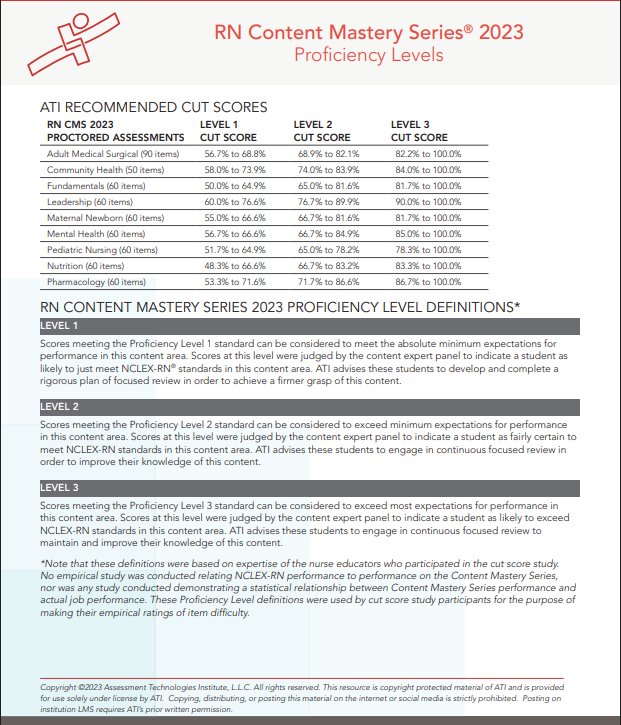
ATI uses proficiency levels, not simple percentages. Many students misunderstand what this means.
Most programs reference three levels:
- Level 1 shows basic understanding
- Level 2 reflects solid application
- Level 3 signals strong clinical judgment
Around 2021, many schools raised their minimum expectation to Level 2. That shift aligned with NCLEX emphasis on decision-making rather than recall. Skipping a question does not cause a penalty. Every question carries equal weight. Difficulty adjusts slightly, but speed does not improve scoring. Faculty reports highlight one pattern. Students who rush often score lower, even when they know the material.
Proficiency levels explained without confusion
How schools usually respond to results
Score handling depends on program policy. Some schools apply the score to course grades. Others use it as a benchmark only. Level 1 often triggers a review plan. Level 2 usually meets progression rules. Level 3 reflects strong readiness. Remediation now follows a clearer path. Many programs assign focused review instead of full course repetition. Faculty often look at reasoning errors, not content gaps. Students benefit when they ask early how their program handles results. Clear expectations reduce panic.
Mistakes that repeat every exam cycle
Certain mistakes appear in every exam cycle. They do not reflect lack of effort. They come from habit and stress. Students who spot these traps early often avoid easy point loss.
Comfort talk that sounds right but scores low
Many students choose answers that feel kind. The exam looks past tone and checks purpose. Statements that rush comfort often shut down the patient. Responses that reflect feelings and keep space for discussion score higher. The goal stays support, not reassurance.
Skipping over warning signs
Some questions hide risk in plain sight. A single phrase can signal danger. Self-harm cues shift priorities at once. Teaching plans and future goals can wait. The exam rewards nurses who act fast to protect safety.
Treating mental health like med-surg
Psychiatric care follows a different path. Control and trust matter more than quick fixes. Students lose points when they apply medical logic to emotional care. Strong answers focus on connection and calm, not symptom control.
Study habits that hold up over time
Preparation methods evolved after 2020. Passive reading lost impact. Active review gained ground. Short, focused study sessions work better than marathon review days. Many strong performers review one disorder group per session. Practice questions help only when followed by reflection. Understanding why an answer works matters more than counting correct answers.
Students who practice rephrasing patient statements often gain instinct for therapeutic responses. This skill translates directly to exam performance. Light timing during practice helps reduce exam-day stress. Heavy time pressure during study does not.
How much preparation is usually enough
Most students do not need months of study. Many perform well with steady review over a few weeks. Short daily sessions work best. Long cram days often cause burnout. Students who review one topic at a time show better retention. Signs of readiness include calm question review and consistent reasoning. Signs of risk include rushing and second-guessing every choice. Preparation works best when it feels controlled, not frantic.
How nursing programs shifted their approach over time

From 2019 through 2022, many nursing schools adjusted how they used ATI results. Pressure eased in some programs. Retakes became more common. Some schools replaced course failure with structured remediation. The goal shifted toward support rather than removal. That phase did not last forever.
After 2023, expectations rose again. Schools restored stricter standards but kept better systems in place. Support stayed available. Accountability increased. Remediation changed focus as well. Instead of more content, programs looked at how students think through questions. Faculty reports showed a clear pattern. Low scores often came from poor test strategy. Knowledge gaps played a smaller role than expected.
Myths that distract students before the exam
Many students carry false ideas into the exam. These ideas increase stress and reduce focus.
- Some believe speed improves scores. It does not.
- Some believe kindness always wins. It does not.
- Some believe diagnosis names matter most. They do not.
The exam rewards balance, safety, and clarity. Letting go of myths helps students think like nurses, not test-takers.
Worries that distract students without helping
Many students stress over things the exam does not judge. These fears add pressure but do not affect scores.
- The exam does not rate empathy at the bedside.
- It does not test memory of DSM terms.
- It does not judge confidence or personality.
- It does not punish doubt or careful thinking.
The exam measures one skill. It checks how a nurse makes decisions inside written scenarios. Nothing more.
How top scorers approach the exam
High scorers share a calm approach. They do not rush. They pause before they answer. They take time to understand what the question asks. Many read the question stem more than once. They look for risk signs first. Safety always comes before comfort or teaching. This habit shows up in strong scores across recent exam years.
The exam rewards clear judgment. Speed does not help if logic breaks down. Careful thinking leads to better choices. The best answers reflect real nursing priorities, not textbook phrases. Students who shift their mindset often see improvement. They stop racing the clock. They focus on the role of the nurse. Scores tend to follow that change.
Clear judgment depends on focus and mental clarity, especially under pressure.